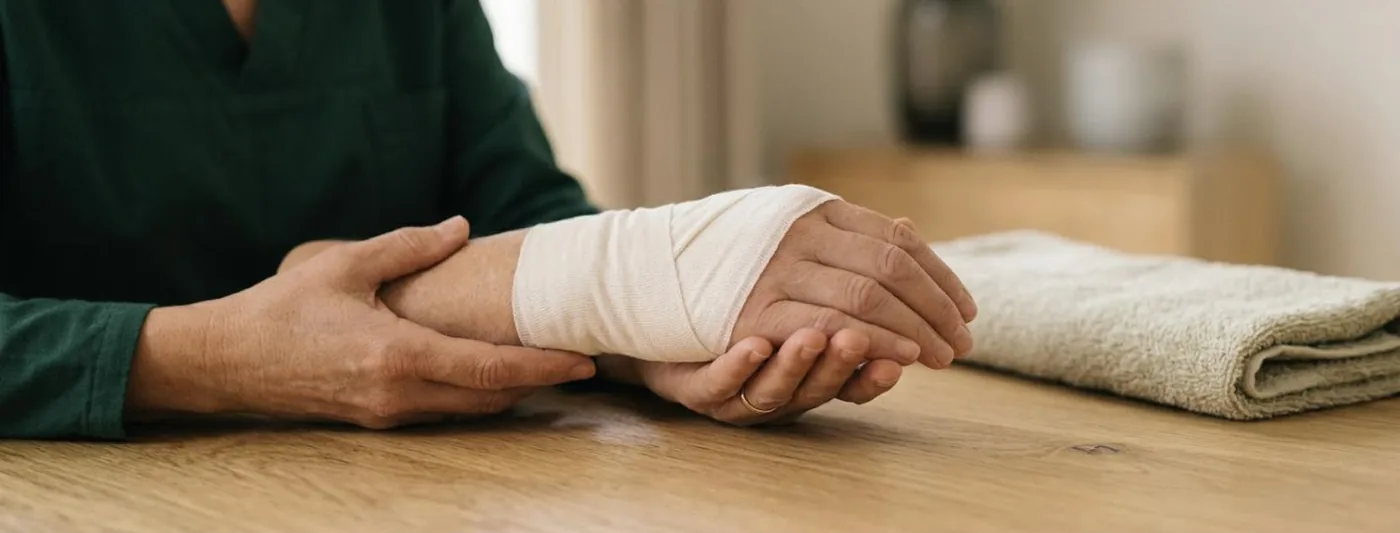
When does hand therapy start after hand surgery?
That depends on the operation. After tendon repairs and many soft-tissue operations, hand therapy starts within the first days, sometimes while the dressing is still on. After other operations you wait two to three weeks until the wound is stable. What counts is the prescription from the surgeon who operated.
There is no single date on which aftercare begins. After a repaired flexor tendon, guided movement often starts in the first week, because a tendon that does not move grows into the tissue around it. After some bone operations and after a ligament repair, rest comes first, because otherwise the tissue does not become firm; after a stable fixation with screws or a plate, on the other hand, movement often starts early. Throughout, a distinction is made between the passive parts of the musculoskeletal system, meaning bone, ligament and cartilage, and the active parts, meaning tendon and muscle.
As rough points of reference: after about two weeks the stitches are usually removed, either in occupational therapy or at the GP practice. Depending on what your doctor has ordered, the affected region may normally be moved again after four to at most six weeks. Movement without load is often allowed considerably earlier.
So hand therapy works to one simple principle: what the surgeon who operated has laid down always comes first. They know the repair, the stability of the fixation and the state of the tissue. Where something found on the internet and the aftercare protocol contradict each other, the protocol from the surgeon holds.
- Bring the aftercare protocol or the operation report to your first appointment.
- Clarify which movement is allowed, which is forbidden, and from when that changes.
- Ask how long a splint is worn and when the next check-up is due.
- Get in touch early: the prescription and an appointment need lead time, and the first week goes by quickly.
In Switzerland occupational therapy requires a doctor’s prescription. It is billed to the insurer responsible. What the deductible (Franchise) and the retention fee (Selbstbehalt) mean for you is something that insurer tells you.
What applies in the first days, while the wound is fresh?
In the first week it is about the wound and the swelling. The hand stays above heart height as much as possible, the dressing stays dry and clean, and the joints you have been cleared to move are moved. Whatever was not operated on should keep moving: shoulder, elbow and the free fingers.
Keeping the hand raised is the most effective thing you control yourself in this phase. Above heart height, tissue fluid drains away instead of pooling. What is meant is not the hand on a cushion beside you but the hand above the heart, at night as well. In the first three to five days this effort pays off most.
The dressing stays dry until the wound is closed. Showering works with a cover; bathing and swimming do not. A dressing that is damp or has slipped must be changed as soon as possible and not left until later. A shoulder that hangs in a sling for two weeks goes stiff in its turn, so move the arm several times a day as far as the instructions allow.
When do the stitches come out and when does scar treatment begin?
On the hand the stitches usually come out after ten to fourteen days. After that the wound may get wet, provided it is dry and closed. Scar treatment begins once the wound is shut: carefully around the scar first, then on the scar itself.
What scar treatment can achieve
A scar is not finished when the stitches come out. It goes on remodelling for about a year, often longer, and during that time it can be influenced. In therapy the scar is moved against the tissue underneath so that it does not stick to tendons and fascia, and the skin is kept greased, because fresh scar tissue has no sebaceous glands. If the scar is sensitive to touch, it is desensitised: the skin is accustomed to touch with different materials, several times a day for short spells.
Scar massage and silicone sheets are widespread, and the evidence is thinner than that spread suggests. A Cochrane review of silicone sheeting for raised scars rates the certainty of the evidence as low to very low. Neither does harm and many people find it pleasant, but it is not a promise of an inconspicuous scar.
- Only treat once the wound is fully closed, never on crusts or open areas.
- Better several short spells a day than one long, firm session.
- Protect the scar from the sun in the first year, otherwise it stays darkly discoloured.
- If the scar becomes red and raised instead of flatter, it needs a medical look.
Why is the hand swollen after the operation and what helps?
Swelling after hand surgery is normal. The tissue reacts to the operation, and the hand has little room for fluid. It becomes a problem when the swelling stays: protein-rich fluid turns thick, the joints lose their play, and a thick hand becomes a stiff hand.
The strongest remedy against swelling, oedema in the technical term, is your own muscle pump. Every full fist and every full opening of the hand pushes fluid out of the tissue back into the circulation. That is why almost every aftercare protocol carries the same instruction: a few movements several times an hour, within what you have been cleared to do, rather than one long exercise programme once a day.
- Raising the hand above heart height, consistently in the first days, later as needed.
- Moving the joints you have been cleared to move, often and briefly.
- Compression with a finger sleeve or a glove, if the wound allows it.
- Draining techniques in therapy, which start centrally at the trunk and only then work towards the hand.
In the first days after the operation, cooling can help against the swelling because cold narrows the vessels; whether and for how long you cool is set by the clinic. Warmth is used carefully across the whole period, to loosen tissue or to improve the circulation in the fingers. Warm water baths with movement exercises only come into question once the wound has healed and the stitches are out.
What does a splint do, and what does immobilisation cost?
A splint protects the repair or the bone from pull and holds the joints in a safe position. That is its benefit. Its price is stiffness: a joint held still loses movement, and tendons stick to their surroundings. So immobilisation is kept as short and as targeted as possible.
Splints are fitted individually in hand therapy, because a hand after an operation matches neither the average nor the other hand. A protective splint holds the operated structure still and leaves the remaining joints free. A resting splint holds the hand in a position in which the ligaments stay at length. A splint with a pull works against a restriction of movement that has already set in.
Immobilisation is therefore not rest but a trade: safety against movement. If you wear the splint longer than ordered, expect movement to come back markedly more slowly. If you leave it off too early, in the worst case the repair gives way. A question in therapy or at the clinic settles what applies in your case.
- Clarify whether the splint is worn day and night or only at certain times.
- Clarify whether it may come off for washing and for exercises.
- Pressure marks, redness and numbness under the splint should be reported, not endured.
- A splint that slips, or becomes too wide once the swelling goes down, has to be adjusted.
How does the build-up of load work after hand surgery?
The build-up runs in steps. First movement without load, then movement against light resistance, then gripping and holding in everyday life, and last strength and endurance. Each step is only cleared once the previous one works without an increase in pain and swelling. Clearance comes from the surgeon who operated.
- Movement without load: guided and active movement within the range you have been cleared for, several short spells a day.
- Light resistance: gripping soft objects, holding light loads close to the body.
- Everyday life: getting dressed, brushing your teeth, turning a key, opening a bottle, increasingly with the operated hand.
- Strength and endurance: targeted strengthening and longer tasks, and last of all heavy lifting and tools.
The measure is how the hand reacts the next morning. A pull during the exercise that settles again shortly afterwards is usually fine. Pain or swelling that lasts into the next day means the dose was too high. Then you go back a step rather than stopping, because a hand that does nothing for three weeks loses ground again.
Most of this work happens between appointments. A home programme with a few clearly described exercises works better than a long list that is ignored after a short time. Exercise sheets to print out are in the documents for patients.
When may I go back to work after hand surgery?
There is no general number of weeks for that. What decides it is the operation, how healing goes, and what the job demands. Office work is usually possible considerably earlier than work with tools or heavy lifting. Your doctor certifies the incapacity to work, not the therapy.
Figures circulate freely, but they rarely stand up. Surveys of specialists show that recommendations differ widely even for the same operation, and the biggest difference lies not in the operation anyway but in the workplace. Someone who works at a screen goes back differently from someone who operates a press or lifts patients.
What makes sense is a staged return rather than a cut-off date: reduced hours, adapted tasks, longer breaks, and only then the full demands of the job. In therapy the grips and loads of your own workplace can be set up and practised before the job asks for them again for the first time.
- Talk to your employer early about adapted tasks rather than about a date.
- After an accident the aftercare usually runs through accident insurance; the deductible and the retention fee only fall away if the accident is covered by your employer’s compulsory accident insurance, otherwise they apply as they do in illness.
- If the incapacity to work drags on, an early-detection notification to the invalidity insurance (IV) can make sense; it is possible from around thirty days of uninterrupted incapacity to work.
- Assistive devices and adapted tools are often the simpler answer than yet more training.
If you have a doctor’s prescription and want to know how quickly the aftercare can start, ask through booking an appointment. For people who cannot easily come to us after the operation, treatment at home is possible where the prescription provides for it, in Thalwil and in the neighbouring communities on the left bank of the lake.