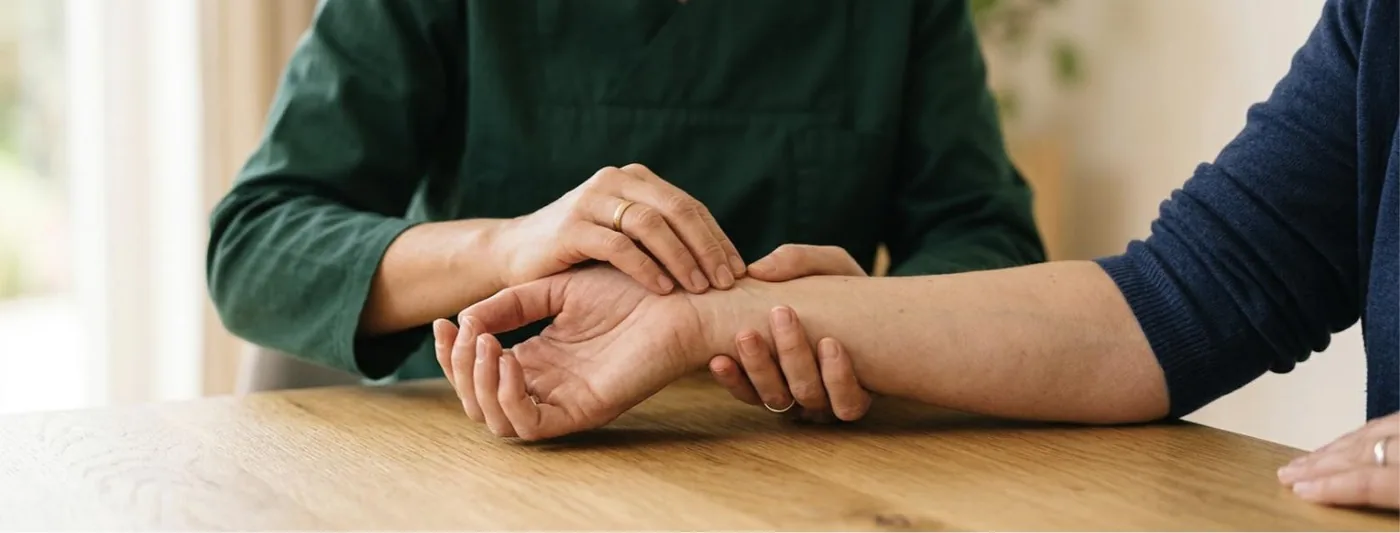
What is carpal tunnel syndrome?
The carpal tunnel is a narrow passage on the flexor side of the wrist. Nine flexor tendons and the median nerve run through it. If anything inside swells, the space becomes too tight for the nerve and its sheath. That is where the odd sensations in thumb, index and middle finger come from.
The floor and the sides of the tunnel are formed by the carpal bones, the roof by a tight band. The median nerve carries sensation from the thumb, index finger, middle finger and the thumb side of the ring finger, and it drives the muscle below the thumb. The little finger does not belong to it, which helps to tell the conditions apart.
The tunnel cannot widen. If the tendon sheaths swell after unaccustomed work, or the body holds fluid, as in pregnancy, an underactive thyroid, diabetes or inflammatory rheumatic disease, the nerve gives way first because it is the softest structure in the tunnel.
So carpal tunnel syndrome is not simply a typist’s complaint. On current evidence, keyboard work alone does not cause it. More often it goes with firm gripping, with vibration and with a sharply bent wrist.
Why does the hand fall asleep at night of all times?
The wrist bends while you sleep, and in that position the pressure inside the carpal tunnel rises several times over. That is why the tingling wakes you, and why shaking the hand out helps for a few minutes. The main treatment starts exactly there, with the position of the wrist at night.
The first sign is almost always the same. You wake up, the fingers feel furry, there is tingling like after a knock on the elbow. You shake the hand out or let it hang out of the bed, and it gets better. For many people this works for a while, sometimes for years.
What happens if nothing is done
- The night-time symptoms turn into daytime ones, for example while driving or holding a phone.
- The fingers feel numb, as if you were wearing a thin glove. Feeling small objects becomes harder.
- Last of all the strength goes. The key turns less easily and the glass slips. The muscle below the thumb visibly flattens.
How is carpal tunnel syndrome established?
Your doctor makes the diagnosis, never the therapy. The hand falling asleep at night points so clearly in one direction that, together with an examination of sensation, strength and muscle shape, it is usually enough. The finding is confirmed with a nerve conduction study.
This measurement, the nerve conduction study, counts as the most reliable method. It also shows how far the nerve is already affected. An ultrasound can add to the picture if it stays unclear. X-ray, CT and MRI are of little use for this question.
The result matters for the treatment as well. Whether the nerve is mildly or severely affected helps decide whether to try without surgery or whether an operation is on the table. So bring the report with you to the first appointment.
What helps without surgery?
The best evidence is for a splint that holds the wrist at night in slight extension of no more than thirty degrees. Alongside it come changes to grip and workplace and, if a doctor prescribes one, an injection. How well an injection works depends above all on how long the nerve has been compressed.
The night splint
A splint that holds the wrist straight at night is the best supported measure short of surgery. It does not treat the cause, but it takes away the pressure peak that makes the night hard. Many people sleep through again after a few nights.
The position is what decides. A splint that bends the wrist backwards raises the pressure in the tunnel just as a bent-forward position does. The neutral position is what matters; a splint made to fit usually sits better than an off-the-shelf one. In hand therapy we shape it from warm thermoplastic directly on your hand, until it sits and leaves the fingers free.
Steroid injection and nerve gliding exercises
A steroid injection into the carpal tunnel, where a doctor orders one, brings many people clear relief. It is given by a doctor. Those who respond well to it usually do well with surgery too.
For nerve gliding exercises, movement sequences that let the nerve slide gently back and forth in the tunnel, the evidence is thinner than their popularity suggests. We use them alongside other measures, since they do no harm and some people notice a difference. There is no proof that they prevent an operation.
When is surgery needed?
When symptoms persist despite the splint, when the numbness has become permanent, or when the measurement shows a clearly damaged nerve. The operation divides the tight band over the tunnel, and the pressure is gone. Your doctor decides on timing and method.
The operation itself is small. The timing is what gets underestimated: odd sensations usually settle quickly after surgery. Sensation and strength lost over months come back more slowly, and sometimes not completely.
Waiting therefore does not simply postpone the operation, it costs the prospect of a good result. That is why this text says more than once when a medical assessment is due.
What happens in the time after the operation?
A dressing and early finger movement in the first week, stitches out after ten to fourteen days, then scar treatment. Light activities return after two to three weeks, firm gripping much later. What your surgeon says always takes precedence over any of these figures.
- Week 1: A thick dressing protects the wound. The fingers are moved from the start, and that is exactly what stops tendons sticking and the hand swelling. The hand is kept raised, not rested.
- Day 10 to 14: The stitches come out. As soon as the wound is closed, the scar may be treated.
- After the stitches, usually from day 14: scar massage, a few minutes several times a day, in small firm circles. Over weeks this keeps the tissue supple and makes the scar less sensitive to pressure.
- Week 2 to 4: Light everyday activities come back. Firm gripping and pushing up on the palm do not yet.
- Week 4 to 12: Building strength, fine motor skills and load up to the demands of your work. When you go back to work depends less on the calendar than on what you do.
What does occupational therapy do here?
It is the craft around the nerve: splint fabrication before the operation, and afterwards the scar, swelling, sensation, strength and the return to work. That includes a look at your grips and tools, so the nerve does not come under pressure again. The aim is a hand that does what you need it for.
- Splint fabrication. We make the night splint individually and adjust it if it presses or slips.
- Scar treatment. Massage, instructions for home, and where useful a silicone sheet and getting the scar used to pressure.
- Swelling and movement. So the fingers do not stiffen while the wound heals.
- Sensation. Targeted sensory training when the fingertips are numb or oversensitive.
- Strength and fine motor skills. A measured build-up instead of all or nothing.
- Workplace and return to work. We look at how you grip, and change what would put the nerve under pressure again.
For practising at home we have exercise sheets to print, free and without registration. They do not replace treatment, but they keep what was worked out in therapy present between appointments.