What is a hand splint for in the first place?
A hand splint has four jobs: to rest, so tissue can heal; to correct, when a joint has gone stiff; to replace what a paralysed muscle no longer does; and to protect, when you go back to work. Which of these your splint does decides when and how long you wear it.
The difference is not academic. A splint that protects tissue after a tendon repair may not be off for an hour. A splint that takes load off the thumb in osteoarthritis goes on exactly when you open the jar.
Just as important is the difference between a thermoplastic splint made to fit and an off-the-shelf model. The made-to-fit splint is warmed in a water bath and shaped directly on your hand; it follows the bony points, spreads the pressure over a large area and leaves free exactly those joints that should stay free. An off-the-shelf model follows an average hand. It can be enough for a short period and for simple tasks, but it presses more often, blocks more joints than needed, and cannot be reshaped once the swelling goes down.
The four jobs
- Resting: after a fracture, a repair or inflammation. Tissue only heals if it is not pulled on all the time.
- Correcting: a joint that no longer straightens fully is guided gently over hours into the direction it is missing.
- Replacing: if a nerve fails and a muscle with it, the splint holds the hand in the position it can grip from.
- Protecting: going back to work or to sport, when the tissue takes some load but not yet all of it.
If you do not know which of these four your splint does, ask. The answer decides whether a forgotten evening is harmless or costs weeks. In hand therapy that explanation is part of fitting the splint.
What is the difference between a static and a dynamic splint?
A static splint holds a joint firmly in one position. It protects and takes load off. A dynamic splint allows movement and guides it, through an elastic pull, a spring or a wire. It draws a stiff joint gently over hours into the direction that is needed again.
Static splints are the majority. They hold wrist and fingers in a position where the ligaments are evenly tensioned, so nothing shortens while nothing moves. They forgive a lot, which is why they come first in the acute phase.
Dynamic splints work with a small, constant force. The pull is deliberately weak: a stiff joint does not give way to a strong tug but to a long, light stretch. Tightening it to speed things up produces irritation and not movement. The force is set, not guessed, so please do not adjust the elastic yourself.
Why is a made-to-fit splint better than one off the shelf?
A made-to-fit splint is shaped from warmed plastic directly on your hand. It bears where your hand can take pressure and leaves free what should stay mobile. An off-the-shelf splint fits an average hand. On yours it presses at the bony edges and blocks joints that should be working.
Thermoplastic material softens in a hot water bath, can be laid over the hand in that state, and hardens again as it cools. What comes out is an impression of your hand with its bony points, its swelling and its dressing. That is why fitting takes a while, and why the result sits differently.
What fitting achieves in practice
- The pressure spreads over a large area instead of two edges. That is the main reason made-to-fit splints cause fewer pressure marks.
- Only the joints that should be blocked are blocked. For every extra joint held still there is a mechanical reason why it stiffens: movement then goes through the free joints, the blocked one is no longer taken through its range, and capsule and ligaments shorten.
- When the swelling goes down, the straps are taken in and the shape is rewarmed. An off-the-shelf splint cannot do that.
- A dressing underneath, or an external fixator, a metal frame fitted from outside to hold a fracture: the splint is built around it.
That does not mean an off-the-shelf splint is never any use; for short relief it can be enough. But as soon as a repair, a fracture or a stiff position is involved, the exact fit is what counts.
How long and when do I have to wear the splint?
That is on your therapy plan and nowhere else. After an injury it is often weeks around the clock, for night-time symptoms only the night, in osteoarthritis only for heavy work. Wearing a splint longer than needed costs strength and movement. Ask when you may take it off.
Immobilisation is a trade: you buy healing and you pay with movement. A joint that stands still for weeks goes stiff, the capsule shrinks, and the muscles waste because they have nothing left to hold.
So hand therapy splints as sparingly as is defensible: as few joints as possible and for as short a time as possible, with movement in the breaks. If your plan sets times off, those are not rewards, they are treatment. The exercises in those breaks keep the joint moving that the splint would otherwise stiffen.
A night splint is a special case. In carpal tunnel syndrome it is worn because the wrist bends in sleep and the nerve is compressed. The studies on it are thin, though: a few small ones of low to very low quality, and some of them found no clear effect. Trying it is defensible; a guarantee it is not.
In finger osteoarthritis the splint is often a tool for particular tasks. It goes on when the fingers face a load and comes off when the load is over. Wearing it all the time gains nothing here and weakens the muscles that guide the thumb.
What do I do when the splint presses?
A freshly fitted splint may feel unfamiliar, but it must not hurt. Take it off after the first hour and look at the skin. Redness that has gone after twenty minutes is normal. If it stays, the splint needs adjusting. Please do not work on it yourself.
- Take the splint off after the first hour of wear and look at the skin, ideally in daylight.
- Draw a ring around any red areas with a pen so you can find them again.
- Wait twenty minutes without putting the splint back on.
- Look again: if the redness has gone, it was contact pressure. If it is still there, it is a pressure mark.
- With a pressure mark, phone the practice. Do not leave off a protective splint after a repair or a fracture; keep the hand still until the appointment. A splint that only takes load off, or is worn at night, you may leave off until then. Adjusting it is a short appointment, not a new start.
The most common pressure marks are where there is little skin over a lot of bone, such as the little-finger side of the wrist and the base of the thumb. Those areas are relieved during fitting. If it still presses, the swelling has usually changed.
A strap pulled too tight does the same as an edge that is too narrow: it dams things up. As a rule of thumb one finger must fit flat under every strap. Pulling tighter so the splint stops slipping congests the hand; a splint that slips has become too wide and needs adjusting.
How do I clean the splint, and what does heat do to it?
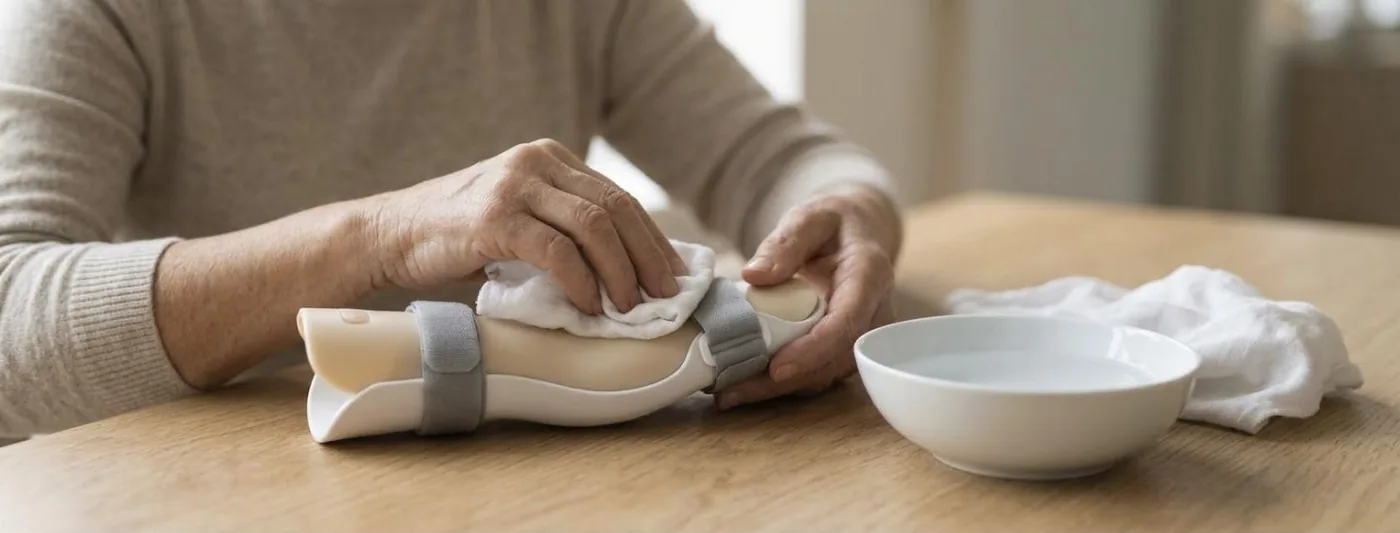
Wash the splint daily with cold or lukewarm water and a little soap, brush out the holes with an old toothbrush and dry it. Please do not use hot water: the plastic softens again with warmth. The same goes for radiators, ovens, dishwashers and a car in summer.
If the splint has to be worn around the clock and can never dry properly, we may provide two identical ones so that one is always dry. Please raise it with us rather than skipping the cleaning.
The material of your splint is mouldable precisely because it reacts to warmth. What is wanted in the water bath at the practice happens unintentionally in a car behind the windscreen. The upper limit is around fifty degrees, and a windowsill in July reaches that faster than you would think.
Where splints get ruined
- In a closed car, on the parcel shelf or on the dashboard.
- On a radiator, supposedly to dry.
- In the dishwasher, the washing machine, the oven, a steriliser.
- Under hot water while washing up, or in a hot shower.
- On the windowsill in summer sun.
The straps are the other wearing part. Hook-and-loop fastenings clog with skin flakes and lint and then stop holding. Brushing them out helps for a while, after that they are replaced. Let straps dry in the air and never put the splint on damp.
If the splint smells after a few weeks, that is sweat in the ventilation holes, not the material. Daily washing with soap and brushing out the holes is usually enough. Avoid solvents and strongly perfumed products; they attack plastic and skin alike.
What happens to the skin under the splint, and how do I shower?
Under the splint the skin gets warm and damp. It softens, becomes tender and after a few days it smells. Wash the hand once a day with mild soap, dry between the fingers, and put the splint back on only once the skin is completely dry.
Softened skin tears more easily and lets germs through. The daily check and thorough drying are therefore not cosmetic. Pay particular attention to the webs between the fingers and the crease at the wrist.
Showering and washing up
- Shower without the splint if you are allowed to take it off. Dry the skin fully afterwards, then put it on.
- If you may not take the splint off, protect it with a waterproof cover and do not shower hot.
- For washing up and cleaning, the splint comes off or goes into a glove. Wet straps dry slowly and soon smell.
- If you sweat a lot, wear a thin cotton sleeve under the splint and change it daily.
- Do not put cream on just before putting the splint on. Cream belongs in the time without the splint, otherwise it slips and the skin softens further.
Itching, blisters, flaking or weeping skin are not a case for more cream but for a medical assessment. The same goes for redness that spreads from the edge of the splint or becomes warm.
In everyday life the splint needs a fixed place. Leave it on the edge of the bath while showering and you will eventually find it warped behind the radiator. A hook or a basket in the bathroom prevents many of these losses.
When does a splint need adjusting?
A splint is not a finished piece of furniture. If swelling goes down it becomes too wide; if swelling comes it becomes too tight. When you can no longer get a finger under the strap, when it slips, when an edge presses or a strap stops holding, it belongs in therapy.
In the first weeks after an injury the hand changes most. A splint that fitted perfectly on the day it was made can be too wide ten days later because the swelling has settled. It then holds nothing in place.
Reasons for a short appointment
- The splint slips, tilts when you grip, or can be pulled off with one hand.
- A strap can no longer be closed so that one finger fits flat underneath.
- Redness appears repeatedly in the same place and stays longer than twenty minutes.
- The plastic has a crack, an edge has become sharp, or warmth has warped the shape.
- The phase of treatment changes: what was meant to rest the hand should now only protect it.
Adjusting usually means warming and reshaping, not making a new splint. It takes a short time. Carrying on for weeks with a slipping splint costs time in the aftercare that is hard to make up. If you are unsure whether it is worth it, get in touch; a short description on the phone is often enough for us to judge.