Which assistive devices bring most in daily life?
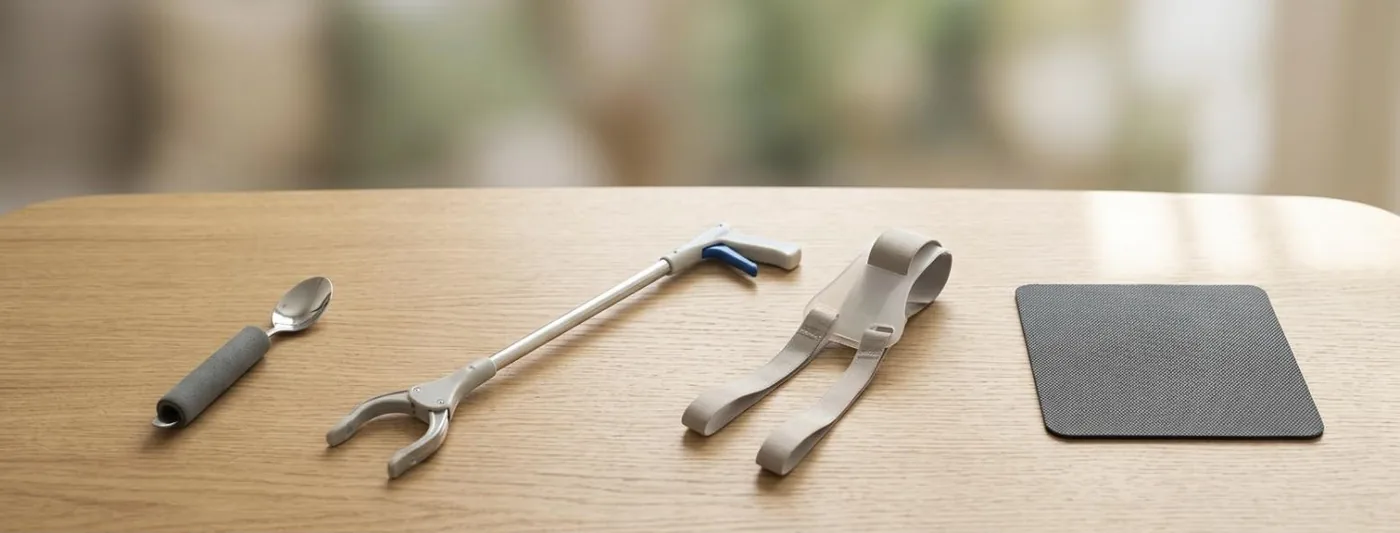
The ones that help most sit in a place you pass every day and where you already improvise: a grab rail where you steady yourself at the basin, a shower stool, an aid for putting on stockings, a thicker grip on cutlery, a non-slip mat under the plate and an opener for screw-top lids.
All six share the same feature: they replace something you already do, only more safely. Anyone who steadies themselves at the basin is today gripping a place that was not built for it. Anyone who turns a lid with a tea towel has recognised the problem, and the device takes the place of that makeshift solution.
- A grab rail where you hold on today at the basin or at the shower door. It replaces the edge of furniture that gives way.
- A shower stool, when standing in the shower becomes unsafe or takes too long. Showering sitting down is often what makes showering alone possible at all.
- An aid for putting on stockings, when back, hip or knee no longer allow bending to the foot. It frequently decides whether dressing succeeds alone.
- A thicker grip on cutlery, toothbrush, pen or razor, when the fingers can no longer put enough strength into the grip.
- A non-slip mat under plate, chopping board or bowl, when one hand has to do the work alone.
- An opener for screw-top lids, because cooking often fails there first and then nutrition follows.
These objects only become effective through the details: the height and the side of the rail, or the seat height of the stool. That is decided in your bathroom, not in a catalogue. With it goes the restriction: what is well evidenced is a targeted assessment of the home in people at raised risk of falling, not the effect of the single object. In a Cochrane review of 2023 the studies on self-care aids and devices were too varied to derive a reliable figure from them.
Which devices typically end up in the cupboard?
What gets left are the devices bought for an imagined situation rather than for the life actually lived. No device is bad in itself; some have a higher chance of no longer being used: grabbers, bath boards, the routine kit after a hip replacement, wheeled frames that do not fit through the door, and walking sticks at the wrong height.
- The grabber. It is often handed out because it costs little. It is used only when something light regularly lies out of reach. If bending is itself the problem, rearranging the cupboards helps more.
- The bath board. It assumes that you can lift one leg over the edge of the bath while sitting. Anyone who can do that usually does not need it; anyone who cannot will not get in with it either.
- The routine kit after a hip replacement. A raised toilet seat, a dressing aid and movement restrictions are handed out to a standard pattern in many places. A Cochrane review of 2016 found only evidence of very low quality for that, and in one study the participants without a prescribed kit were more satisfied with their recovery. What applies after your operation is what the clinic says.
- The wheeled frame that does not fit through the door. It stands in the stairwell and is used only outdoors, while indoors people go on holding on to the furniture.
- The walking stick at the wrong height. Too long, and the shoulder pulls up. Too short, and you walk bent. The height is set and checked, not estimated.
- The electronic device nobody has set up. Reminder and emergency call devices rarely fail on the technology and often on the first change of battery.
No object on this list is bad in itself; each is exactly right for somebody. The question is never whether a grabber makes sense, but whether it solves a problem you actually have, and it is precisely that question a device bought in advance skips over.
Why do devices that were bought go unused?
Because they were chosen without the person. In a survey of 227 adults with various impairments, 29.3 per cent of all devices were abandoned altogether. Four reasons were associated with that: the users’ opinion did not count in the choice, the device was too easy to obtain, it achieved too little, or the need had changed.
Devices were abandoned above all in two windows of time: in the first year and after more than five years. The first shows a choice that did not fit. The second shows that a device which once fitted does not grow with the person. Mobility aids were affected most often.
On top of that comes something that appears in no statistic. A device is visible and tells the neighbour, and yourself, something about how things stand. Anyone who was never asked whether they wanted it puts it away as soon as nobody is watching, and that is not stubbornness but the answer to a decision made over their head.
A further reason is more mundane: nobody showed how it works. An aid for putting on stockings fails at the first attempt almost every time. Anyone who tries it without instruction concludes after two goes that it is no good.
Where does a grab rail belong in the bathroom?
Where you already hold on today. As a rule that is the change from standing to sitting and the way in and out of the shower, not the middle of an empty wall. The height follows your own hand in the movement and not a standard measurement from a brochure.
- Walk through the bathroom the way you really walk through it, and let somebody watch. Wherever your hand reaches, that is where the rail belongs.
- Mark the place with a strip of tape and leave it there for a few days. A place that still fits after three days is usually the right one.
- Check the substrate. A grab rail has to carry your whole body weight, including a sudden pull. A tile over a cavity or a stud wall does that only with the right fixing.
- Only then fit it, and go through the movement twice, in and out again.
Towel rails, soap dishes and shower rails are not grab rails. They tear out of the wall under a pull, and exactly when you would need them most. What the effort achieves can be quantified: a Cochrane review of 2023 found that removing hazards at home lowered the fall rate by about 26 per cent, and by about 38 per cent at high risk of falling. Without raised risk the same measure showed no benefit. More on this in the article on fall prevention.
Outside the bathroom the same applies. The second important rail is often at the edge of the bed, the third at the front door, where shoes are put on standing up. Which places belong on your list is shown in the article on the age-friendly home.
Why are trying out and instruction so decisive?
Because an object only becomes an aid once the movement with it is secure. In a study at a rehabilitation centre the abandonment rate fell from 37.3 to 9.5 per cent after the need was no longer assessed by a doctor alone but in a team, with occupational therapy in it.
The figures come from a single study of a small group of people with multiple sclerosis, and not from Switzerland. As an order of magnitude they are still usable, because they point in the same direction as the four reasons for abandonment: what decides whether a device is used is the assessment, not the object.
- Trying out happens in your own home, at the activity that actually gives trouble.
- At least two versions are compared, so that you feel a difference and can decide.
- Height, side and grip thickness are adjusted, and the result is then checked rather than assumed.
- Practice happens in both directions, so sitting down and standing up, dressing and undressing.
- Cleaning is discussed too, and what to do when it does not work.
- A date is agreed some weeks later to look at whether it still fits.
The follow-up check is the part most often dropped, and that probably explains the second window after five years. A shower stool that was right after a fracture can be too low two years later. This adjustment belongs to the job, as treatment at home too, where the prescription provides for it.
Who pays for an assistive device in Switzerland?
That depends not on the object but on your situation. Before the reference age, invalidity insurance pays for aids that serve integration. After it, the Old Age and Survivors’ Insurance covers only a short list. For the consequences of an accident, accident insurance is responsible, and for certain items used in treatment at home, health insurance.
- Invalidity insurance (IV). It provides aids that make employment, a field of duties, self-care, getting about or contact with the world possible. You apply to the IV office of your canton of residence; devices are provided in a simple and appropriate version, and expensive ones often on loan. Anyone who received an IV device before pension age keeps the entitlement as long as the conditions are still met; that is called acquired rights. Two people with the same need can therefore be equipped differently.
- Old Age and Survivors’ Insurance (AHV). After the reference age the list is short. It contains among other things wigs, orthopaedic shoes, speech aids after an operation on the larynx, hearing aids, magnifying spectacles and wheelchairs without a motor. Shower stools, grab rails, dressing aids and lid openers are not on it.
- Health insurance. Through the list of medical aids and appliances (Mittel- und Gegenständeliste), items are reimbursed that serve the examination or treatment of an illness and that you, or a person not professionally involved, apply yourself. Depending on the category a prescription is needed that names the material explicitly, as a rule from your doctor. It matters because it establishes medically that the costs are covered by the insurer responsible. Certain products can also be prescribed by a nurse.
- Accident insurance. After an accident it covers the aids that become necessary because of the consequences of that accident.
- Supplementary benefits. They can reimburse costs of illness and disability, explicitly including the cost of aids. The responsible office is the one in your canton.
- Paying yourself and renting. Many of the everyday aids from the first section are on none of these lists. They are bought or rented, partly through non-profit organisations and through Spitex (home nursing and home care).
Clarify who is responsible before you buy, because a device already bought is rarely reimbursed afterwards. On amounts and on reimbursement in an individual case, your health insurer, the compensation office and the IV office give information; this text names no amounts, because they change continually.
The assessment itself is separate from that. Occupational therapy is billed to the insurer responsible on a doctor’s prescription; the deductible (Franchise) and the retention fee (Selbstbehalt) run through that insurer. The object is funded independently of this.
How do you proceed before you buy anything?
Do not start with the object but with the activity that no longer works. For one week write down where you get stuck and which of it bothers you most. Only after that does it become clear whether an aid, a rearrangement or practice is the right answer.
- For one week, note every activity you give up, postpone or manage only with help. Then put them in order of what bothers you most.
- Have the home looked at rather than described. What sounds in conversation like a problem with the kitchen is often, on site, one of cupboard height.
- Try before you buy, where possible with a loan device and over several days.
- Clarify who is responsible and apply where an application is needed.
- After some weeks, check whether the device still fits, and have it readjusted if it does not.
For points two, three and five, occupational therapy is there. In geriatrics the assessment for assistive devices is at the core of the work, and it takes place where the problem occurs. If you are unsure, write us a line through the contact form about what has stopped working.