What is Dupuytren’s contracture?
Under the skin of your palm lies a firm sheet of fibres, the palmar fascia. In Dupuytren’s contracture, connective tissue cells there multiply and lay down collagen. Palpable nodules form, and from them tough cords. These cords slowly shorten and pull the fingers into flexion. The tendons themselves are not affected.
The palmar fascia anchors the skin of the palm to the skeleton, so that the hand can grip without the skin sliding away. In Dupuytren’s disease, tissue of this sheet is remodelled, and the cells involved can contract; that is what separates a harmless thickening from a cord that pulls a finger.
Many people take the hardening for a tendon problem, because the cord stands out like a string when the hand is opened. The flexor tendons lie deeper and are healthy. That is why the finger can often still be bent passively while straightening stays blocked.
The disease is benign and does not spread. In some people, related hardenings show up on the sole of the foot or over the knuckles. Your doctor makes the diagnosis, never the therapy: a nodule in the palm can also come from a cyst or from a tendon sheath.
How does a nodule in the palm start?
It usually starts with a firm nodule in the palm, often level with the ring or little finger. In this phase it can be tender; later it rarely is. A cord grows from the nodule towards the finger. Only when that cord shortens does the loss of extension appear.
- Nodule: a hard spot in the palm, often stuck to the skin.
- Skin sign: dimples or a crease form over the nodule.
- Cord: the hardening runs as a band towards the finger and stands out when the hand is opened.
- Flexion contracture: the finger no longer straightens fully, usually at the knuckle first.
The course is slow and uneven. Years without change are possible, then it moves on within a few months. Some people stay at the nodule and never develop a contracture. At the start that cannot be predicted.
For treatment, what counts is which joint is pulled. A loss of extension at the knuckle can usually be corrected well. At the middle joint of the finger it is more stubborn, because capsule and ligaments shrink over time. That is why a procedure is advised earlier there.
Who gets Dupuytren’s contracture?
Men are affected several times as often as women, usually from midlife on, and the frequency increases with age. The predisposition is inherited and is common in northern Europe. People with diabetes, with epilepsy, with liver disease and those who have worked for years with strongly vibrating tools are also affected more often.
Heredity weighs heavily. If you have relatives with Dupuytren’s, fall ill early, have both hands affected or also have nodules on the sole of the foot, expect a less favourable course. That changes little about the treatment, but it explains why some people are operated on several times and others never.
Manual work on its own does not set off Dupuytren’s. There are signs of a raised risk from years of work with strongly vibrating machinery, not from ordinary office or household work.
Can a Dupuytren’s cord be trained away?
So far, no. On the present state of research there is unfortunately no reliable treatment that dissolves an existing cord, and no splint that reliably stops it progressing. Strong stretching of the bent finger does not help and can injure tissue. Movement preserves what is still mobile, but it does not replace a procedure once the hand no longer goes flat.
This answer is uncomfortable, because the internet says the opposite. Exercise programmes, stretching gadgets and massage rollers are advertised for it. From a clinical point of view there is unfortunately no evidence that a cord regresses through therapeutic measures. Specialist societies state that splints do not prevent progression and that pulling hard on a bent finger can do harm.
- Movement keeps supple what is still mobile, and preserves strength. It does not turn a cord back into normal tissue.
- A cortisone injection can settle a painful nodule. It does not stop the progression.
- In early stages without loss of extension, radiotherapy is occasionally offered. Your doctor decides on benefit and risk.
What makes sense is watching and adapting. If you do the table-top test on yourself now and then, you notice in good time when an assessment is due. In hand therapy the work is then about grips that function despite the loss of extension, and about tools that need less palm.
What is the table-top test and when is a procedure discussed?
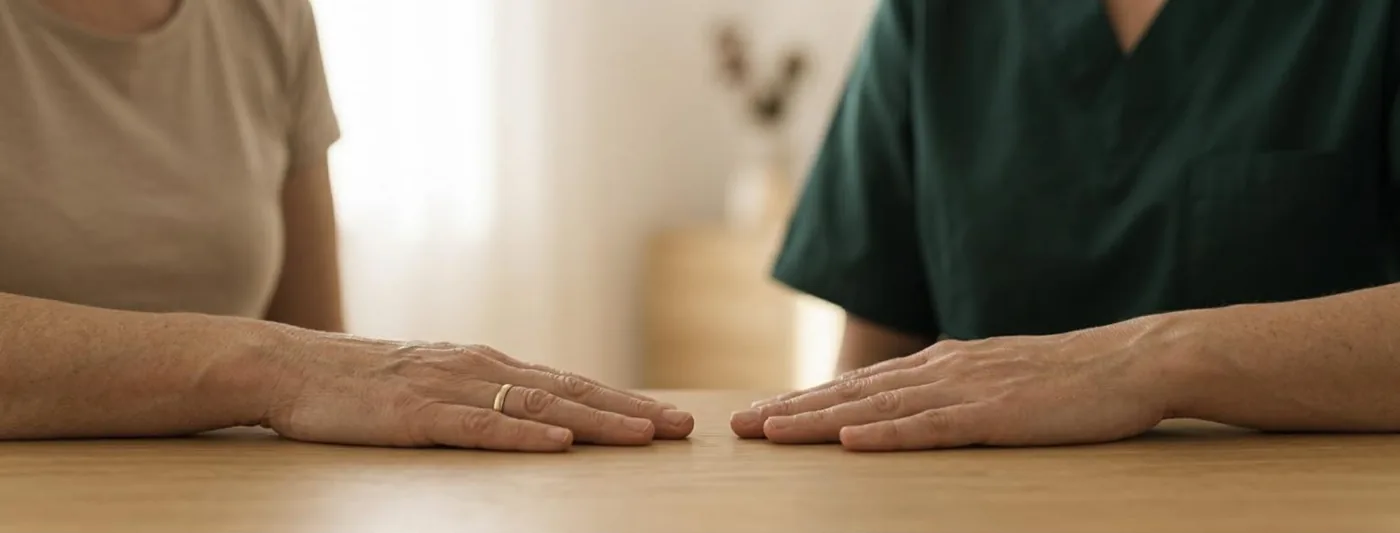
For the table-top test you lay your hand flat on a table. If the palm stays on the surface with all fingers, the test is normal. If a finger or part of the palm lifts off, it counts as positive. That is the usual reason to have a procedure discussed with hand surgery.
The test measures what matters in daily life: whether the hand will open. It needs no equipment. Photograph the flat hand from the side, and in six months you will see whether anything has changed.
In the consultation, the degrees missing to full extension are measured, separately for each joint. As a guide value for a procedure, a loss of extension of around thirty degrees at the knuckle applies. At the middle joint it is advised as soon as a deficit begins, because capsule and ligaments shrink there over time and the correction becomes more difficult. Alongside that, how much you miss the hand in daily life stays decisive.
Which procedures are there for Dupuytren’s contracture?
Three ways are in use: percutaneous needle fasciotomy, in which the cord is divided through the skin with the tip of a needle; open surgery with removal of the diseased tissue; and injection of an enzyme into the cord. Which one fits depends on the cord, on the joint affected and on your situation.
Needle fasciotomy
Under local anaesthetic the cord is weakened through the skin until it gives way, and the finger is straightened. It needs no incision and usually no stitches; the hand is usable again within a few days. The diseased tissue does stay in the hand, though, and the bent position returns earlier on average.
Open surgery
Through a zigzag incision the diseased tissue is removed. That heals more slowly but lasts longer on average. The nerves and vessels of the fingers run close beside the cord, so the operation is more delicate than the small wound suggests. With a deficit at the middle joint, or with a recurrence, this is usually the route chosen.
Injection into the cord
An enzyme is injected into the cord and dissolves its collagen fibres; the finger is straightened the following day. In Switzerland such a preparation was licensed for some years; distribution has since been discontinued. Whether an injection procedure can be offered in reasonable time should be clarified with hand surgery.
How does the aftercare work after a procedure?
The wound needs rest, the fingers need movement. Both start early: exercises in the first days, stitches out after about two weeks. Then follow scar care, treatment of the swelling and building up strength. A night splint is mostly used as a precaution, though not every case needs one; whether the loss of extension returns is checked as you go.
After open surgery the palm is swollen and the fingers are stiff. That settles if the hand is kept raised and moved gently and regularly. Usual aftercare plans set out short exercise spells several times a day rather than one long one. Firm gripping stays out of it in the first weeks.
- Wound: keep it clean and dry, stitches as a rule after about two weeks.
- Swelling: keep the hand raised, move the fingers, and with persistent swelling wear a compression finger sleeve.
- Scar: once the wound has healed, care for it and mobilise it gently; firm massage too early irritates more than it helps.
- Extension: straighten actively several times a day, in short spells, up to the limit and not beyond.
On the splint a precise statement is worth making, because it is often prescribed across the board. A randomised study found no difference in hand function and loss of extension after open surgery when a night splint was added to hand therapy for everyone. It makes sense where extension starts to fall away again, and then it is fitted.
A residual deficit can remain, above all at the middle joint. For daily life, the last degree of extension counts for less than whether the hand fits flat on the table again. Hand therapy in this phase brings the swelling down, keeps the scar supple and builds grips back up; with a prescription it is best to arrange an appointment before the stitches come out.
Does Dupuytren’s come back after the operation?
Yes, that happens. The procedure removes the cord, not the predisposition. After needle fasciotomy the bent position returns earlier on average than after open surgery, but the recovery is shorter. How often a recurrence occurs is reported very differently across studies, because even the term is defined differently.
One paper counts every new nodule as a recurrence, another only a loss of extension of twenty degrees or a second operation. That is why the figures in the literature diverge widely, and why none is given here; anyone who hears one should ask what was counted in it.
A procedure buys time and function, it does not cure the disease. A second procedure at the same place is more demanding, because scar tissue and nerves are harder to separate. So get in touch again as soon as extension falls away. Through the contact form we will work out with you whether an appointment makes sense.