What is osteoarthritis in the fingers and the thumb?
Osteoarthritis is wear of the joint cartilage. In the hand it most often affects the thumb base joint and the small finger joints. The cartilage thins, the bone builds up at the edge, the capsule thickens. The joint hurts under load, feels stiff in the morning and gradually loses movement.
Cartilage covers the joint surfaces and spreads the pressure. In osteoarthritis this layer becomes thinner and rougher. The bone underneath reacts and builds up at the joint edge, forming what are called osteophytes. Capsule and ligaments thicken. The joint becomes broader and harder, and its range narrows.
At the thumb there is something particular. The thumb base joint, the saddle-shaped joint at the root of the thumb, carries the mobility of the whole thumb: it allows bending, straightening, moving away from the hand and bringing the thumb across to the fingers. It buys that freedom with very little bony guidance. Grip firmly and you press on that small surface with a multiple of the finger force.
In the hand, osteoarthritis often runs in episodes. For weeks a joint is warm, swollen and tender, then it settles again. The thickening stays. Many people have their worst pain in an early phase and not when the X-ray looks at its worst.
Your doctor makes the diagnosis, never the therapy. Examination and X-ray separate osteoarthritis from other causes, such as rheumatoid arthritis, tendon sheath inflammation at the thumb, or gout.
Which joints are affected first?
It most often begins at the thumb base joint, at the end joints of the fingers and at the middle joints. Bony thickening at the end joints is called Heberden’s nodes, at the middle joints Bouchard’s nodes. The wrist itself is usually spared. Which joints are involved is shown by the examination, with an X-ray where needed.
- The thumb base joint at the root of the thumb: pain when unscrewing, turning a key, wringing out a cloth and doing up buttons.
- The finger end joints, Heberden’s osteoarthritis: the knobbly thickening sits right at the outside, just under the nail.
- The finger middle joints, Bouchard’s osteoarthritis: the joint becomes spindle-shaped and thick, and the fist no longer closes fully.
The nodes are not soft-tissue swelling but bone. They do not go away, even when the pain eases later. At the end joints a small, tightly filled cyst can form alongside them, press on the nail bed and make the nail grow with a ridge.
What is typical is involvement of both hands and of several joints at once, often mirrored. That distinguishes finger osteoarthritis from osteoarthritis after a fracture, which hits exactly one joint.
Why are women affected more often?
Women are affected markedly more often than men, and symptoms often begin around the menopause. Why that is has not been settled. The falling oestrogen level, greater ligament laxity and heredity are all discussed. Evidence for hormone therapy against hand osteoarthritis is so far lacking.
The timing around the menopause is striking and has been studied for a long time. Observational studies found fewer joint replacements at hip and knee among women on hormone replacement therapy. A completed clinical trial that specifically includes people with hand osteoarthritis is not known to us. No treatment can therefore be derived from the hormone level.
More certain is the family pattern: if you know a mother or a grandmother with knobbly finger joints, your own risk is higher. Alongside that come factors that are known and partly within your control.
- Age, by a long way the strongest factor.
- Earlier injuries or fractures at the affected joint.
- Work and hobbies with high, repeated grip force.
- Excess weight, which in osteoarthritis also acts on joints that carry no body weight.
The hand carries no body weight; here joint protection starts with grip force instead.
What does joint protection mean in everyday life?
Joint protection means doing the same task with less force and spread over more joints. Large handles need less force than thin ones. Loads belong on the flat hand or the forearm, not in a pinch grip. Pushing is kinder than carrying. The European specialist society recommends this teaching to everyone affected.
Joint protection is not going easy on the hand. You keep moving, but you take the force from a different joint and from a different direction; across a day that is the difference between a hand that burns in the evening and one that stays quiet.
In the advice session we look at the tasks that actually hurt you and find a different way of doing each one. You then take it away in writing; our information sheets for patients set out the rules with pictures.
What do assistive devices and a thumb splint do?
Assistive devices lower the force needed by lengthening the lever or thickening the handle. A thumb splint steadies the base joint and eases the pain; in studies the splints tested mostly did better than a sham treatment. The European specialist society recommends splints for thumb base osteoarthritis explicitly, also over longer periods.
An assistive device uses physics: a longer lever lowers the force needed, a thicker handle spreads the pressure, a firm surface takes the counter-holding off the hand, and an electric appliance replaces the turning altogether.
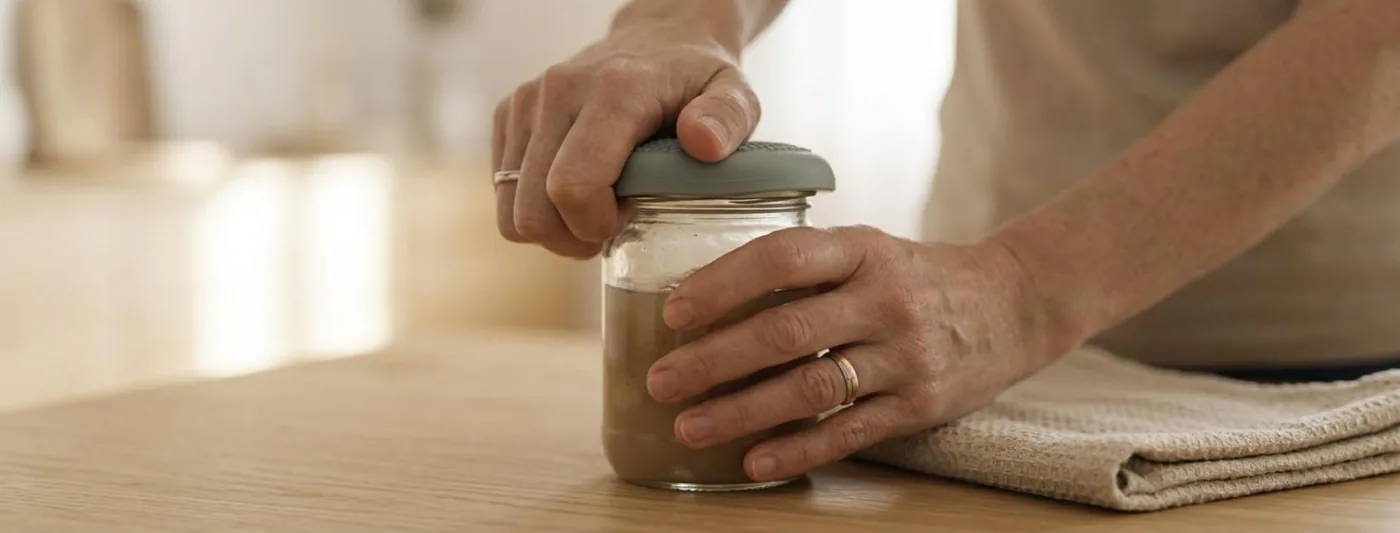
- Openers for screw caps and twist lids that lengthen the lever.
- Handle build-ups for cutlery, pens, toothbrush and garden tools.
- Non-slip mats, so the other hand does not have to hold against.
- Key turners and large door handles instead of round knobs.
- Light pans and containers with two handles.
- Electric appliances for everything that would otherwise be turned, grated or pressed.
The thumb splint has a different aim: it holds the base joint in a position where it hurts less, and limits the movement that sets the pain off. It has to allow gripping, or it will not be worn. In practice a splint is either shaped from thermoplastic material or chosen as a ready-made model and then reshaped.
The limits of the evidence belong here too. That splints reduce pain is shown by several comparative studies. Which design is best, short or long, soft or firm, is not settled by that. One network analysis put the long firm splint ahead for pain and the short firm one for function, but described the overall evidence itself as unclear; what suits you shows up in the wearing.
What part do movement and strength play?
Movement and targeted strengthening are part of the standard treatment. The proven benefit is small, though: in an international review, pain fell on average by half a point on a scale up to ten, and the evidence counts as being of low quality. After six to twelve months the effect was no longer detectable.
That figure is sobering and still no reason to stop exercising. The muscles around the ball of the thumb guide the base joint. If they are strong, the metacarpal bone slides less far out of its socket under load. And movement that is lost is hard to get back.
So in hand therapy we exercise in several directions, and in measured doses.
- Movement: keeping the span of the thumb open, so that gripping around thick objects stays possible.
- Stability: activating the short thumb ball muscles against light resistance, without provoking the pain.
- Strength: building up grip and key-turning strength slowly, with soft material and few repetitions.
- Coordination: practising the rounded grip arc that spreads the force across several fingers.
The dose decides. Pain that appears during the exercise and settles quickly afterwards is fine; pain that lasts hours or makes the joint swell was too much. What suits you we work out in hand therapy in Thalwil, starting from the tasks you are missing in daily life.
When does surgery come into question?
Surgery comes into question once pain and loss of function remain although joint protection, splint and medication have been exhausted. At the thumb base joint the trapezium is usually removed; at the finger joints the joint is fused or replaced. No procedure at the thumb has proved superior in comparative studies. The decision lies with hand surgery.
The order is clear in the recommendations of the European specialist society: first education, assistive devices, exercises and a splint, with pain treatment where needed, and only then the question of an operation. Surgery stands there for people with structural change in whom the other measures have not eased the pain enough.
For the thumb base joint the recommendations name trapeziectomy, the removal of the trapezium, the small carpal bone at the root of the thumb. In rarer cases the scaphoid is removed as well, which is called scaphoidectomy. A review of eleven randomised studies with around 670 participants found no evidence that any of the additional techniques does better than simple removal for pain and function; the additional procedures went with more unwanted events. The quality of that evidence is low to very low.
At the finger end joints the joint is usually fused; at the middle joints it is fused or replaced depending on the findings. Each of these operations is followed by hand therapy aftercare, and the clinic that operates sets the time frames. An appointment for the aftercare can be arranged before the operation.