What does fine motor skill actually consist of?
It is not one single ability but five building blocks working together: dosing force, the different types of grip, sensation in the fingertips, the two hands working together, and guidance by the eye. If one block fails, the whole hand seems clumsy although the strength is there.
When someone says the hand has become clumsy, they usually mean something more precise. Naming it is worth the effort, because each block is trained differently.
- Dosing force: gripping firmly enough that nothing slips, and loosely enough that nothing is crushed.
- Types of grip: the pinch grip for a coin, the key grip along the side of the thumb, the three-point grip for a pen, the fist grip for a door handle. Fine motor skill also means changing between them without looking.
- Sensation: the feedback from the fingertips about whether something is slipping, whether it is round or has edges.
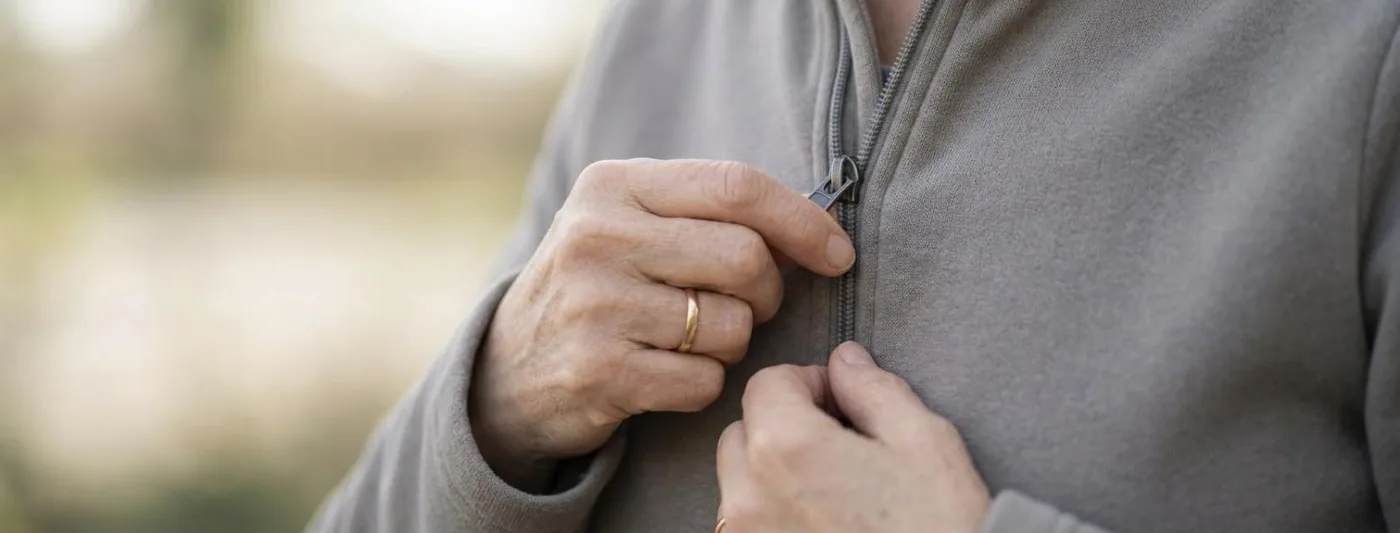
- The two hands working together: one hand holds, the other works. With a zip, one holds the bottom while the other pulls.
- Guidance by the eye: the eye finds the target before the hand sets off. If the feedback from the hand is disturbed, the eye takes over that work, and that costs attention.
A strengthening device achieves little if strength is not the problem. The other way round, fine gripping sometimes fails because there is not enough strength to hold: see a weak grip.
Why does no fine movement work without sensation?
Because the fingertips steer the force. While you grip, the pressure is continually matched to how slippery the object is, with a narrow safety margin; if something slips, the hand corrects within fractions of a second. If the fingertips are numb, that regulation fails. Then you grip too hard, or lose the object without noticing.
A classic study of the precision grip measured how hard people grip when an object is smoother or rougher. The grip force matched the friction, with a narrow margin above what was needed to hold on. Small slips were compensated by the hand within six to eight hundredths of a second.
When the skin of the fingertips was locally anaesthetised, that matching broke down. People with numb fingertips live this daily: the glass slips although the strength is there, or the tomato is crushed, because it is sensation that steers the movement.
Disturbed sensation is common after a stroke. In one small study, 41 to 63 per cent were affected in the first week, depending on which sensation was tested. The link between sensation and hand skill grew closer over time.
Sensation is trained by telling things apart, not by mere touching: sorting coins by value with your eyes shut, or ordering fabrics by roughness. In a randomised study after stroke this was better than simply handling objects, with an effect lasting over six months. After a repaired nerve injury the evidence is thinner: one review holds that the evidence for classical sensory training is not strong.
What is task-oriented practice and why does it work better?
Practising in a task-oriented way means repeating a whole everyday action rather than moving single muscles: doing up a shirt button, or eating with a fork. The task has a goal and gives feedback. That is what the nervous system learns from, and no transfer into daily life is needed, because daily life is the exercise.
The difference shows up with a squeeze ball. Squeezing it moves muscles, but the exercise has no goal beyond itself, nothing can go wrong, and the grip never changes. Doing up a button asks for the pinch grip, a turn, the second hand on the fabric, and clear feedback: done up or not.
How to recognise a good practice task
- It has a visible result: the button is closed, the coin is in the slot.
- It is just hard enough to fail sometimes, because what always succeeds no longer trains anything.
- It occurs in your own life, unlike a pegboard.
- It can be graded: large buttons before small ones, coins on the table before coins in a purse.
- It can be counted or timed, so that you notice the progress.
The evidence is decent but not overwhelming. A Cochrane review of 33 studies with around 1850 participants found that repetitive task training improved arm and hand function, with low to moderate certainty of the evidence. The effect lasted up to six months after the treatment.
A programme therefore consists of three to five real actions that you have chosen yourself, because you are missing them. Of those you plan two or three firmly into each day.
How many repetitions does it really take?
More than a therapy hour holds. In an observation of therapy sessions after stroke, an average of 32 repetitions of a hand movement were achieved per hour. In a study with deliberately high dosing it was around 300 in the same time. You only reach that number at home, spread across the day.
The observation covered more than 300 therapy sessions at seven sites. Compared with animal experiments on recovery of the brain, which needed hundreds of repetitions, the usual dose is small.
A feasibility study made the counter-test: people with a paralysed arm practised three tasks with a hundred repetitions each, three times a week over six weeks. On average 322 repetitions per hour came together, with little pain and little exhaustion.
The caveat belongs with it: the same Cochrane review found no link between the dose and the result. Many repetitions are the precondition for practising at all; that twice as many would bring twice as much is not shown by this.
As a scale, rehabilitation after stroke usually involves several hours of structured training per week, spread over several days. How that fits into the week after a stroke is set out in the article after a stroke.
How do I build practice into the day rather than on top of it?
By doing nothing extra, but doing what exists more slowly and with the affected hand. Buttons, zips, cutlery, keys and shoelaces come up every day anyway. Leave them deliberately to the weaker hand and you collect repetitions without having to find a slot. The order of the steps you settle with the therapy.
A programme that is meant to happen on top of the day is dropped after two weeks, while one that sits inside the day tends to hold.
- Buttons: in the morning while getting dressed. A shirt has six to eight buttons, and that is as many repetitions before breakfast. Practise on a shirt over the back of a chair at first, later on your own body.
- Zips: close the jacket yourself every time, even if it takes two minutes. A ring on the slider helps at the start and comes off later.
- Coins: pay with cash at the till instead of by card, and at home move coins from a flat hand into the purse.
- Cutlery: the knife into the affected hand, at first a blunt knife for something soft such as banana or bread, because a numb hand does not feel a cut. Cutting asks for dosed force and for both hands.
- Tying shoes: the most demanding everyday grip, because the two hands do different things. First with a thick lace at the table, then on the foot.
- Writing: three lines a day, always the same sentence, at first with a thick pen and large letters. Speed comes last.
In Parkinson’s disease, handwriting becomes smaller as the writing goes on. A cue from outside helps against that: widely lined paper, a dot at the margin as a target size. In one study people practised with such target marks for six weeks. More on this in Parkinson’s in everyday life.
So that you do not have to work out at every action which step is due, therapy gives you an order from the coarse to the fine grip, matched to your findings. General material from the practice is in the information sheets for patients.
What do dual tasks add to the practice?
A dual task is practice with distraction: doing up buttons while counting backwards, sorting coins while holding a conversation. It maps daily life, in which little succeeds undisturbed. In the late phase after a stroke, cognitive-motor dual-task training improved arm function in a summary of studies.
As long as a movement needs your full attention, it is not fit for daily life. At the kitchen table the button works; in the stairwell with the phone ringing it does not, and it is that gap the dual task is meant to close.
- Doing up buttons while counting backwards from 100 in sevens.
- Sorting coins by value while naming towns beginning with one letter.
- Closing a jacket while somebody asks you a question.
The evidence comes from thirteen small studies with a good 300 participants, which is little. The dual task is brought in only once the action succeeds without distraction. And it belongs at the table, not in walking: anyone unsteady on their feet practises distraction while sitting, or divided attention becomes a risk of falling. See fall prevention.
What is mirror therapy and what is it good for?
In mirror therapy a mirror stands upright between the hands. You move the healthy hand and see its reflection where the affected one is. The brain is given feedback that the affected hand cannot supply itself. This has been studied above all after stroke.
The review on it covers 62 studies with just under 2000 participants. For movement of the arm and for independence in daily life it found an advantage, at moderate certainty. Mirror therapy also had a favourable effect on pain, where the evidence is weaker. On neglect of space no clear effect appeared.
The usual dose was about 30 minutes, five times a week, over four weeks. That is manageable at home: a mirror upright on the table, the affected arm behind it, slow movements of the healthy hand, and the gaze on the mirror.
It is the way in for the time when a movement does not work at all yet and therefore cannot be repeated. As soon as some control of your own appears, practice on real actions takes over, and the mirror does not replace that.
After a repaired nerve, the same route serves to map sensation again. The review sees this as one of the promising approaches, but points out the methodological weaknesses of the studies.
How do I make the progress visible?
Most simply with one set action and a clock. Count how many buttons succeed in a minute, or time how long the shirt takes. Another way is to write the same sentence on the same sheet once a week. Both are suggestions, not tasks that must be completed; they make small steps over weeks easy to see.
Fine motor skill improves in steps you do not notice from day to day. Anyone who does not measure has the impression after four weeks that nothing has happened, and stops.
- Time: one set action with the stopwatch on your phone, such as doing up the shirt or collecting ten coins.
- Number: how many repetitions in a day. A stroke on a sheet of paper on the kitchen door is enough.
- Handwriting sample: the same sentence, the same paper, once a week, with the date, because the size of the letters says more than the beauty.
- Self-rating: five actions you are missing, each scored monthly from zero to ten.
In the practice, standardised tests come on top, such as placing nine pegs against the clock. They are useful over time: the same test in the same sitting position, every few weeks.
If the curve stays flat over weeks, that is no reason to stop but a reason to change the task. Usually it has become too easy, or stayed too hard. Making that adjustment is the work of hand therapy; appointments through the booking page.