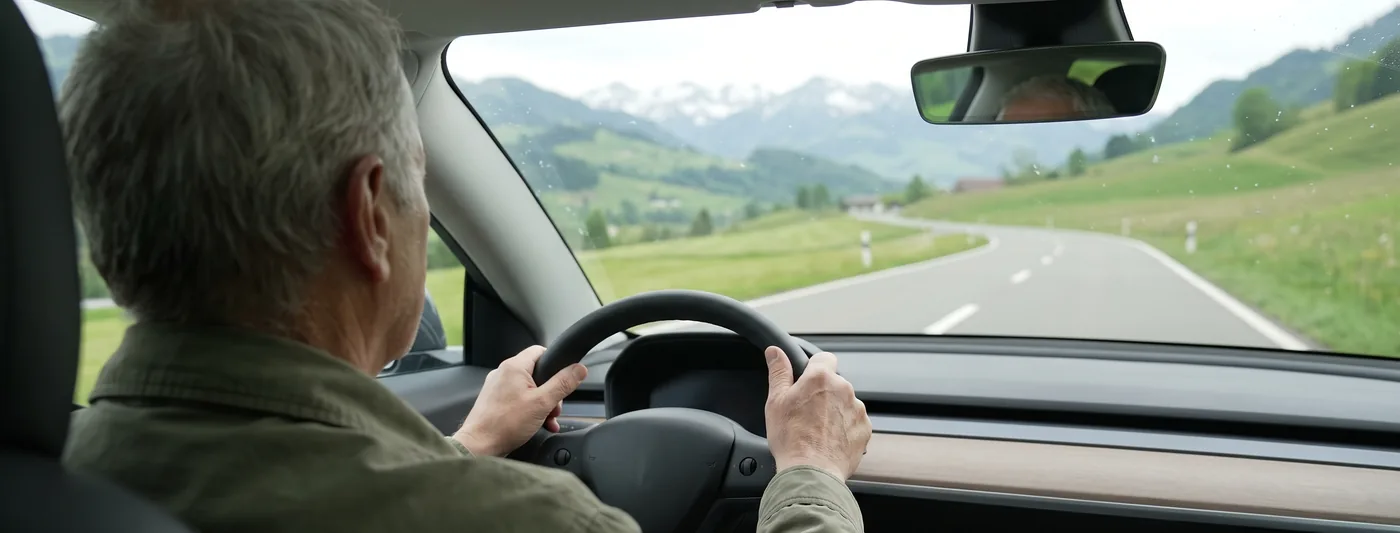
Who decides whether I may drive again after an injury?
For the single trip you decide yourself. The Road Traffic Act requires you to have constant control of the vehicle; anyone not physically or mentally able to do so counts as unfit to drive and must not drive. Lasting fitness to drive, by contrast, is decided by the cantonal road traffic office.
Article 31 of the Road Traffic Act is short. Paragraph 1 requires the driver to keep such control of the vehicle at all times that they can meet their duty of care. Paragraph 2 states that anyone who, because of alcohol, medication or for other reasons, lacks the necessary capacity counts as unfit to drive and must not drive a vehicle.
Those other reasons are the decisive point. A cast or a splint belongs there, a shoulder in a sling, severe pain, a new painkiller, weakness down one side after a stroke. The law gives no list, because it means your state and not a diagnosis.
Driving anyway risks more than a fine. Anyone unfit to drive for other reasons who drives a motor vehicle is liable under Article 91 paragraph 2 to a custodial sentence of up to three years or a monetary penalty. That applies even when nothing has happened.
Nobody signs a clearance for the single trip. A medical report on good healing is not permission for this evening in the rain; you make that judgement afresh every time.
What is the difference between driving ability and fitness to drive?
Driving ability is your state at this moment: rested or exhausted, with or without painkillers and a fresh cast. Fitness to drive means the lasting requirement to drive a vehicle at all, not tied to one occasion. You judge the first before every trip, the authority judges the second.
Traffic medicine keeps the two terms sharply apart. Fitness to drive is the general requirement, not limited in time, for driving a motor vehicle safely. Driving ability is the capability of the moment and therefore temporary. Someone taking painkillers after a hand operation can be fit to drive in general and still unable to drive that day.
Article 14 of the Road Traffic Act requires both. Fitness to drive means, among other things, having the necessary physical and mental capacity. Driving competence means knowing the traffic rules and being able to drive vehicles safely. After a severe injury or a stroke both can be affected, and they are examined separately.
Medication is part of driving ability. Ask explicitly when you are given a new painkiller or sedative. The package leaflet gives a first indication; whether you can drive on it is something you settle with your doctor.
May I drive with a cast, a splint or a sling?
There is no law that expressly forbids a cast or a splint. What is forbidden is driving a vehicle you do not safely control. With a sling or a forearm cast you lack the second grip on the wheel, and what counts for the assessment is not how you feel but what can be shown afterwards.
In its minimum medical requirements for the musculoskeletal system, the Ordinance on Admission to Road Traffic names no diagnoses but a condition: no consequences of injuries or operations with significant effects on the ability to drive a motor vehicle safely that cannot be sufficiently corrected by devices. A cast is not such a device, because it does not correct anything, it restricts.
In practice the emergency manoeuvre decides, not the drive to the postbox. On a straight road a great deal works one-handed. When someone brakes in front of you and you would have to steer and change grip at the same time, the difference shows.
- Can you guide the wheel with both hands and change grip quickly in an emergency?
- Can you reach and use the indicators, wipers, lights and handbrake without a detour?
- Can you last a whole trip, or does the strength fade after ten minutes?
- Can you release the seatbelt and open the door if you have to hurry?
After a wrist fracture the same applies as after a tendon repair or an operation on the thumb. The question is not whether the bone holds, but whether you can call up the movement quickly and without thinking. Discuss it with the doctor looking after you.
What do I risk with the insurer if something happens?
The injured party gets their money: they have a direct claim against the liability insurer. The same insurer can then reclaim from you, as far as it would have been entitled to reduce or refuse its payment. Driving knowingly with a restricting cast can be judged as gross negligence. That runs separately from any criminal proceedings.
Article 65 of the Road Traffic Act sets this out in three steps. The injured party can proceed directly against the insurer. Defences from the insurance contract cannot be raised against them. The insurer does, however, have a right of recourse against the insured person, as far as it would have been entitled to reduce or refuse payment.
Under the Insurance Contract Act an insurer may reduce its payment if the event was brought about by gross negligence. The same appears in the conditions of voluntary comprehensive cover. Driving deliberately with severely restricted movement can be judged as gross negligence; whether it is so in a particular case is decided case by case.
What applies after a stroke?
A stroke as a rule leads to an assessment of fitness to drive and can be accompanied by a precautionary withdrawal of the licence. The examination is carried out by a doctor recognised in traffic medicine at the highest level. Without that decision you do not drive, even if you have long felt fit again.
The ordinance is clear here. Anyone holding a licence during or after severe physical impairment from accidental injury or illness must undergo a traffic medicine check-up. A stroke falls under this, and the examination is at the same time the route back to the wheel.
The procedure is often set off by a report. Doctors may report to the cantonal authority that a person cannot drive motor vehicles safely because of an illness or impairment; for that report they are released from professional secrecy. A cantonal IV office may also report. Where there are serious doubts, the authority can withdraw the licence as a precaution.
If the physical findings are not enough to settle the question, a traffic psychology examination is added. It tests what stays invisible at the bedside: attention over time, reaction under distraction, overview, insight into the illness. The traffic medicine guide expressly names no fixed waiting period for conditions of the brain.
What makes sense for arm and hand in the meantime is set out in After a stroke. For the driving question one thing counts above all: do not declare yourself fit. A driving ban kept costs you weeks; one broken can cost you the licence for good.
What part do vision, neglect, attention and reaction time play?
The visual field with both eyes must cover at least 120 degrees horizontally and be normal to 20 degrees centrally. A loss on one side tears a hole in that. Neglect weighs heavier: those affected miss one side and do not notice. Speed of reaction and divided attention also belong in the assessment.
For category B the ordinance requires a visual acuity of 0.5 in the better eye and 0.2 in the worse one, measured separately. To that come the visual field, freedom from double vision that gets in the way, and twilight vision that is not significantly reduced. Anyone who reaches the values only with glasses must wear them when driving.
Where the ordinance knows a period, it writes it down. For newly arisen sight in one eye only, it requires four months without driving, a certificate from an eye specialist and a passed test drive. That figure applies to that one case. It cannot be carried over to a cast or to a stroke.
A neglect is trickier than a loss of visual field, because the eye is in order. Attention no longer turns to one side. Someone with hemianopia, a loss of half the visual field, usually knows about it and turns their head. Someone with neglect sees a complete picture and misses nothing, and that is exactly what makes it dangerous in traffic.
The minimum medical requirements further ask that consciousness, orientation, memory, thinking and reaction are not significantly impaired. While driving that shows wherever several things happen at once, for example in a roundabout in the rain while the satnav talks. How attention can be trained is set out in cognitive training.
What is a test drive and which vehicle adaptations are there?
Where driving competence is in doubt, the cantonal authority can order a test drive with a traffic examiner, and for questions of fitness to drive a medically supervised one. Anyone who fails loses the licence, and it cannot be repeated. If aids are enough, the licence can be restricted instead of withdrawn.
The test drive is not a lesson but an assessment with a hard consequence: anyone who fails has the licence withdrawn, and the way back runs through a new learner permit. Anyone who fails to appear without an excuse has also failed, which is why preparing well is worth it.
If someone no longer fully meets the minimum medical requirements even with aids, the authority may restrict the licence rather than withdraw it entirely. A doctor at the highest level of recognition judges which restrictions still allow safe participation. Possible are limits of place and time, particular types of road, or being tied to an individually adapted vehicle.
- Automatic transmission, so the other hand can stay on the wheel
- A steering knob for one-handed steering
- Hand controls for accelerator and brake when a leg is weak
- Moving the pedals so the left foot works the accelerator
- Indicators, wipers and lights moved to the opposite side
- Extra mirrors and a wide interior mirror when head rotation is limited
The cost of disability-related changes to a motor vehicle can, under certain conditions, be covered by invalidity insurance (IV) as an assistive device. The cantonal IV office decides that, not the therapy and not the workshop. The application wants making early, because the assessment takes time.
What can occupational therapy contribute, and what not?
Occupational therapy practises strength, movement, stamina and attention in tasks close to driving, and describes in observable terms what works and what does not. You can bring that report into the assessment. It is not a clearance: the authority decides on the licence, traffic medicine on fitness to drive.
We build strength and movement where driving needs them: changing grip on the wheel, turning the key, pulling the seatbelt, holding over time. We practise attention in tasks with distraction and time pressure, and we watch how long the performance lasts.
- Build stamina, so the strength does not fade after ten minutes
- Practise the head and trunk rotation needed for the shoulder check
- Train divided attention and reaction under distraction
- With neglect, practise searching the neglected side systematically
- Observe in daily life and record in writing what works and what does not
What we do not do: we do not certify fitness to drive, we give no driving lessons and we do not replace a test drive. A report from occupational therapy describes observations from everyday life. Weighing them is a matter for the examining doctor.
Treatment at the practice needs a doctor’s prescription; treatment at home requires the prescription to provide for it. It is billed to the insurer responsible, and what the deductible (Franchise) and the retention fee (Selbstbehalt) leave with you is something your insurer tells you. We are happy to answer questions about the process through contact.