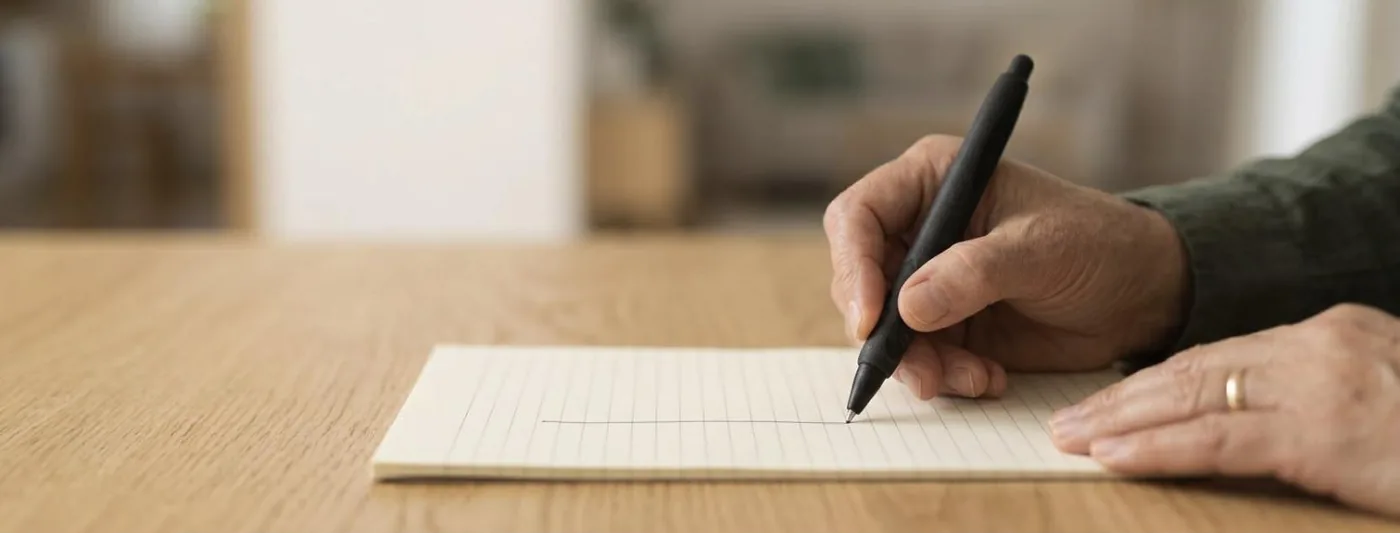
Why does handwriting get smaller with Parkinson’s?
Handwriting gets smaller because Parkinson’s damps the size of movements. The brain sets the movement too small and at the same time reports back that it is big enough. Often the letters shrink further across a line as well, because each repetition comes out a little smaller than the one before.
Behind this lies a process many people hear about early on: in a small region deep in the brain, the substantia nigra, the cells die that produce the messenger substance dopamine. Dopamine is the signal with which the basal ganglia dose movements automatically, meaning they set how large and how fast something is carried out. Without it, movements still run, but they are set too small. That is also what the drug treatment aims at, supplying the brain with a precursor of dopamine or with substances that act similarly.
The technical term for the shrinking handwriting is micrographia. It belongs to the early signs of Parkinson’s disease and is frequently noticed by others first: by the bank at the signature, by the family on the shopping list. The hand is usually not weak. Anyone who makes a fist has strength. What is missing is the setting of movement size.
That is what makes it awkward. Your own feedback no longer matches: what feels normally sized while writing is small on the paper. Anyone who deliberately enlarges believes they are exaggerating, and only then does the writing become legible again.
Two different forms
- The writing is small from the start and stays roughly the same size across the line.
- The writing begins at a normal size and becomes ever narrower, slower and fainter towards the end of the line. That is the so-called sequence effect.
The distinction is not academic. Measurements before and after a dose of levodopa show that evenly small handwriting responds well to the medication, whereas the shrinking across the line hardly does. So anyone who finds that the tablets improve much while the handwriting still frays is experiencing nothing unusual.
What helps against the small handwriting?
What helps is enlarging the movement deliberately and recalibrating that sense of size regularly. In studies, people wrote for six weeks on five days a week for about half an hour with oversized templates. The writing became larger and easier to read; it did not become faster or more fluent.
The other side of that result belongs with it. Training that enlarges the letters makes sense when the goal is legibility. Anyone expecting to write faster and more fluently will be disappointed, because the evidence supports the size and not the speed.
- Choose paper with clear lines, and the spacing may be generous.
- Before writing, draw a few large arcs and waves across the whole width of the line. That calibrates the scale.
- Write deliberately large enough that it feels exaggerated, because the feeling deceives and the page shows the real size.
- Pause briefly after each line and start the next one large again, instead of fighting the shrinking.
- Count aloud or tap the beat if the letters narrow all the same.
The choice of task counts too. Practise writing where you need it, for instance your signature or the shopping list. A thicker pen and a non-slip mat reduce the effort of holding.
How grip strength, fine adjustment and endurance of the hand can be practised in detail is described in the article on fine motor skills. With Parkinson’s there is the additional point that the size of the movement has to be practised as well, not only the accuracy.
Why do movements become smaller and slower?
Bradykinesia means slowed movement, hypokinesia means reduced movement. Both belong to the core signs of Parkinson’s disease. What is typical is that a movement gets smaller with repetition: the step shorter, the letters narrower. Strength is often normal; what is not normal is the setting of the size.
In the brain, dopamine is missing in those nuclei that dose movements automatically. What otherwise runs alongside, the reach when walking and the swing of the arms, is set too small. From the outside that looks like reserve.
The same pattern shows in many everyday actions and not only in writing. The voice becomes quieter without anyone noticing, and you are asked more often to speak up. Turning over in bed suddenly takes several attempts, because the movement does not reach far enough. When brushing teeth the path of the brush gets shorter, and so it does when shaving. A glass is held safely but lifted more slowly. And when getting up from an armchair the forward swing is missing that otherwise comes automatically. In occupational therapy exactly these actions are gone through one by one and deliberately carried out large again.
What follows for practice
If too small is the rule, then too large has to be practised. That is the principle of amplitude training: everyday movements are carried out deliberately exaggerated, with full reach and visible effort, until the scale shifts. Whoever reaches oversized in training should reach a normal distance again in daily life; that is the idea behind it, and evidence for that transfer is so far missing.
- When dressing, guide the arm deliberately far forwards and upwards instead of keeping it close to the body.
- When standing up, bring the nose clearly over the knees instead of hauling with the back.
- When walking, take visibly long steps and think the reach through.
- Apply the same principle to speaking and writing: louder and larger than it feels right.
Programmes of this kind exist under protected names, with their own training courses and a fixed structure. The principle behind them can be built into any everyday action independently of that, from the wardrobe to the stairs.
What is cueing, and how well is it evidenced?
Cueing means that a signal from outside sets the rhythm: a metronome, counting aloud, music, stripes on the floor or a tap on the thigh. The movement then runs through seeing and hearing rather than through the disturbed automatic drive. Walking improves measurably; the effect on freezing is mixed.
The idea behind it is simple. The part of the brain that times movements itself works unreliably; the part that reacts to what is seen and heard goes on working. A beat from outside takes over the job that is missing inside.
- Audible: a metronome, a march in headphones, counting aloud, tapping your own hand.
- Visible: tape stripes across the floor in front of the door, the joints in a tiled floor, your own stick as a finishing line.
- Felt: a tap on the thigh, a vibration signal, a hand on the shoulder.
Precision belongs to the state of the evidence. A summary of several controlled studies of repeated cueing training found an improvement in standing up, walking and turning; whether freezing itself becomes rarer or easier is not established by that, and the trustworthiness of this evidence was rated low. In a broader review of training methods for freezing, a lasting effect after the end of training could not be shown.
From both of those follows a simple expectation for daily life. Cueing is usable and well tried as a tool in the moment, but as a course of treatment with an after-effect it is not evidenced. Anyone who uses it therefore usually uses it permanently, the way one uses glasses, and that is no step backwards.
Pacing: spreading your strength across the day
Alongside cueing there is a second tool that occupational therapy uses at least as often: pacing. What is meant is the deliberate division of strength and time across the day, instead of carrying on until nothing works any more. With Parkinson’s there is the additional point that the effect of the medication fluctuates; demanding activities therefore belong in the windows in which mobility is at its best.
- Split the shopping into two shorter trips in the week rather than one large one on Saturday.
- When cooking, do the preparation in the morning and finish the cooking only in the evening.
- Before an activity that demands concentration, take a short break deliberately, instead of needing one afterwards.
- Put demanding actions such as showering, dressing or an appointment outside the home into the good phase after taking the medication.
- Place a light activity deliberately between two demanding ones, so that the recovery does not slip to the end of the day.
What can you do when the feet suddenly stick to the floor?
Freezing is a sudden block of movement: the feet stay stuck to the floor while the upper body carries on. The episodes last seconds, rarely more than half a minute, and often occur in a doorway, when turning or under time pressure. About half of those affected experience freezing during the course of the illness.
Because the upper body carries on while the feet stay put, freezing is one of the most dangerous everyday situations in Parkinson’s. The triggers repeat themselves reliably: narrow places, door frames, a change of floor covering, the telephone ringing as you set off.
- Stop rather than fight. Pushing forwards strengthens the block and tips the body forwards.
- A clear touch helps many people: a hand placed firmly on the shoulder or the back, short and definite, gives the system a tangible signal to realign itself by. A light tap works less well than steady, clear pressure.
- Shift your weight deliberately onto one leg, then onto the other. That often releases the sticking on its own.
- Set a beat: count one, two, one, two aloud, or hum a march.
- Create a visible target: step over your own shoe, over a stripe on the floor, or over the foot of the person with you.
- Only then walk on, with deliberately large steps.
Companions help best by not pulling anything. Being pulled by the arm makes the block worse and puts both people off balance. It is more effective to stand in front of the person, offer a foot as an obstacle and set the beat.
Why are two things at the same time so difficult?
Walking and talking at the same time runs alongside each other in healthy people. With Parkinson’s, walking needs attention again, because the automatic drive is disturbed. Add a second task and the movement becomes smaller and less safe, and the risk of falling rises. So in daily life: one thing after the other.
That explains observations which are otherwise read as carelessness. Someone who is spoken to while walking and stops can put their concentration onto a single action instead.
- Stand still or sit down while on the telephone rather than walking through the flat.
- Move drinks on a trolley rather than carrying them.
- Put conversation at meals into the pauses rather than mixing the two.
- Free your hands before setting off: put keys, post and bag down first.
The second conclusion concerns breaking things down. Complex sequences of movement succeed better when they fall apart into single, deliberately triggered steps: standing up becomes feet back, slide forwards, nose over the knees, push up. This way of thinking is a core part of occupational therapy in Parkinson’s.
How do buttons, cutlery and dressing become easier again?
Buttons, cutlery and zips become easier when three things come together: a thicker grip, a stable starting position with the elbows propped, and an action broken into single steps. Timing is the fourth: anyone on medication plans fine work for the phase in which it works best.
Timing is often underestimated. In many people mobility fluctuates markedly across the day. Doing up a shirt before the first dose takes effect is a different task from doing it an hour later, which is why it is worth ordering the day around the effect of the medication.
What can be changed about clothing and cutlery
- Larger buttons and wider buttonholes make the same movement possible that failed before.
- A ring or a loop on the zip replaces the pinch grip with a hook grip.
- Thicker, heavier grips on cutlery and pens need less fine adjustment and damp a tremor.
- A high plate rim, a non-slip mat and a propped elbow bring more than any other cutlery.
- Slip-on clothing, hook-and-loop fastenings and shoes without laces save the hardest movements altogether.
These are the same movements that are needed after other neurological conditions; the article on using the hand again after a stroke says more about practising at real everyday actions. The difference with Parkinson’s is that it is not the strength that is missing but the size and the trigger of the movement.
When is it worth adapting the home?
Adapting the home is worthwhile as soon as falls, near-falls or freezing occur at particular places in the flat, not only after the first fracture. The guideline provides for occupational therapy when daily life, work or hand function including handwriting is impaired. The assessment happens where the threshold actually lies.
The advantage of an assessment at home is that the triggers are tied to places. In the same person, freezing occurs again and again at the same spots: in the corridor before the bathroom, when turning in front of the bed. Once they are known, they can be defused.
- Rug edges, thresholds and loose cables out of the routes that are walked several times a day.
- Floor markings or a coloured stripe where things regularly stall.
- Higher seats and firm armrests, because standing up is the commonest fall situation in the home.
- Light on the way to the toilet, with a motion sensor rather than a switch.
- Grab rails where turning happens too, and not only where standing happens.
A sober assessment belongs to occupational therapy itself. Controlled studies show an effect on the self-rated performance of the activities that matter to the people concerned. The course of the illness in the narrower, neurochemical sense is steered by the medication and, in selected cases, by deep brain stimulation. How the illness works out in daily life can very well be influenced: whoever goes on carrying out actions keeps mobility, safety and independence for longer, and occupational therapy deliberately matches its measures to the times the medication works.
Treatment in the practice or at home needs a doctor’s prescription. It is billed to the insurer responsible; what is left with you through the deductible (Franchise) and the retention fee (Selbstbehalt) is something your health insurer will tell you. What belongs to our speciality in neurology is described there; a first conversation can be arranged through the booking page.