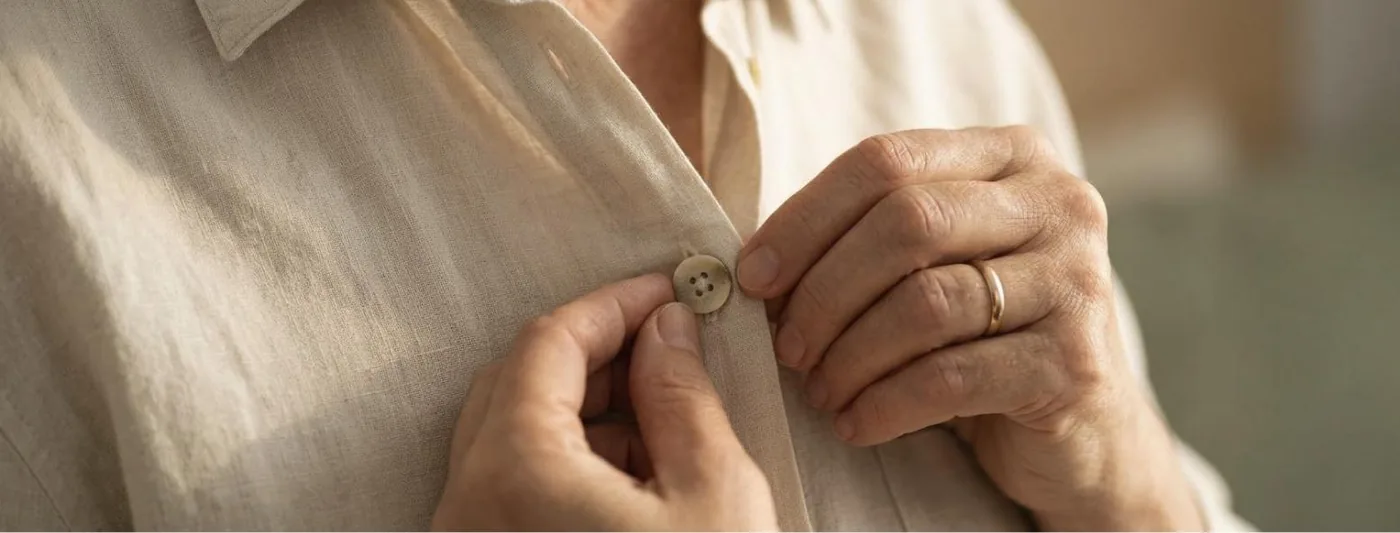
Why dress the more affected side first and undress the less affected side first?
The more affected side is dressed first and undressed last. When you put a garment on it is still completely loose, so the stiff arm finds the sleeve easily. When you take it off, free the less affected side first and the fabric then falls away. The working hand stays free for the difficult step.
The reason is mechanics, not tradition. As soon as the less affected arm is in its sleeve, it is caught inside the garment and can no longer pull the fabric over the stiff shoulder. Undressing follows the same logic backwards: a sleeve with the less affected side already out of it lies loosely around the affected arm.
The second reason is the shoulder. A paralysed shoulder is no longer guided by its muscles and tolerates neither pulling nor sudden movement. Keeping to the order means the affected arm never has to be forced into a position it cannot reach on its own.
- Sit down, both feet flat on the floor. Dressing while standing is a common cause of morning falls.
- Rest the affected arm on your thigh or on a cushion. It should lie still rather than hang.
- Gather the sleeve of the more affected side up to the armhole and lay the garment over your knee.
- Guide the more affected hand into the sleeve and push the fabric with the less affected hand over elbow and upper arm to the shoulder.
- Pull the garment round behind your back, and only then does the less affected hand go into its sleeve.
- Undressing is the reverse: less affected side out of the sleeve first, then free the fabric over back and head, the affected arm last.
For garments that go over the head, the instructions differ from one another in the last step. For jackets, blouses and anything with a full-length fastening the rule is unambiguous, which is why those items are the easier ones to start with.
- Trousers while sitting: cross the more affected leg over the less affected one, pull the trouser leg over the foot, then the less affected leg, and only pull up at the very end.
- Sock: pull the sock over the less affected hand, spread the thumb and guide the foot into the opening.
- Bra: fasten at the front and turn it round, or put the fastened bra on like a shirt.
- Choose clothing that works with you: loose cuts, elastic waistbands instead of zips, large buttons, hook-and-loop fastenings or elastic laces.
How do you eat and drink with only one working hand?
When eating, it is not the cutting hand that is missing but the holding one. Every solution therefore replaces the holding: a non-slip mat under plate and board, a raised plate rim as a counter-support, a board with spikes and a ledge. With those, spreading and cutting work one-handed.
Anyone who has breakfast one-handed for the first time notices quickly where it goes wrong: the roll travels across the plate, the jar tips while being opened. Both are the same problem. What is missing is the counter-pressure the second hand usually supplies.
- A non-slip mat under plate, board and glass. A simple thing that replaces the missing counter-pressure of the second hand and works immediately.
- A board with raised spikes holds bread and vegetables, and a ledge serves as a stop for spreading.
- Plates with a high rim turned inwards: the food can be pushed onto the fork instead of falling off the edge.
- Opening lids: clamp the jar between your thighs and put a piece of non-slip matting between the lid and your palm.
One point is often overlooked: if the more affected hand has some function left, it may hold the plate while the less affected hand eats. That is the most frequent opportunity of the day to use that side at all. More on hand function itself is in After a stroke: using the hand again.
How do personal care and showering work with hemiplegia?
In the bathroom the seat decides everything. A shower stool turns a balance task into a hand task, and suddenly showering is possible again. Add a screwed-on grab rail and a non-slip mat. A hand shower in a holder at seat height keeps one hand free for washing.
Showering while standing demands balance on a wet surface, with the eyes closed while washing your hair and only one hand available for support. Sitting down removes that part of the task.
- Grab rails should be screwed on where possible. Suction-cup rails work loose unnoticed and give way once weight is on them.
- A hand shower with an adjustable holder, soap and shampoo as pump dispensers within reach of the less affected hand.
- A small towel instead of a flannel is easier to grip one-handed; to wring it out, loop it around the tap.
- Rest the affected arm in the basin or on your thigh while washing rather than letting it hang.
- To dry your back, hang a towel over the back of the chair and dry yourself against the fixed towel.
The armpit and the palm of the more affected side are the places most often forgotten. If the fingers are hard to open, moisture collects there and the skin becomes sore. Those two places belong in the daily routine, washed and dried carefully.
How do you get from the bed to the chair, and in which direction?
For an independent transfer the chair stands on the less affected side, angled slightly towards the bed, with the brakes on if it is a wheelchair. You slide to the edge of the bed, put both feet flat, lean the upper body far forwards and turn over the less affected side onto the seat.
The direction is not a detail. With the chair on the less affected side, the working hand can take the armrest and the leg on that side can carry the turn. With the chair on the more affected side, neither is available.
- Place the chair or wheelchair on the less affected side, slightly angled. For a wheelchair: brakes on, footplates swung away, the armrest on the bed side folded back.
- Slide to the edge of the bed until both feet are flat and the toes are under the knees.
- Rest the affected arm on your own thigh, do not let it hang and do not pull on it.
- Lean the upper body far forwards until your nose is over your toes. Only that brings weight onto the legs.
- Stand up, or lift your seat, and travel to the seat surface in two or three small turns, correcting the feet after each turn.
- Sit down under control, lean back, and only then position the affected arm comfortably.
In therapy and nursing care, transfers are also deliberately made over the more affected side, guided and with support, so that weight comes onto that side. That is a supervised exercise and not a route for everyday life between two people. Which version suits you is something we look at together in therapy.
Why should the more affected side join in everyday life?
Because the less affected side does every task faster, and the affected one is therefore passed over day after day. What is not used is not activated, and the activation fades further. Specialists call this learned non-use: less remains than would actually have been possible.
Joining in does not mean the more affected hand takes the task over. It may play the easier part and hold or counter-hold, for instance steadying the board while the other hand cuts.
- Pick a few fixed actions a day in which the more affected side has a job. A small number of actions that reliably happen achieves more, in our experience, than an extensive plan that sinks in daily life.
- Put objects down so that the more affected side covers part of the distance rather than the less affected hand doing the whole reach.
- Where strength is absent, positioning is the job: the arm rests supported, the shoulder does not hang on its own weight.
One distinction must not be lost here. Someone who neglects a side because it is slow can decide differently. Someone who neglects it because the brain no longer attends to it has no such choice, and the next section is about that.
What is neglect, and how does it show in everyday life?
Neglect is a disorder of attention: the brain no longer turns of its own accord towards one half of space and of the body. The eyes see, but what is seen is not attended to. After a stroke of the right hemisphere, neglect persists in about 30 to 40 of every 100 people affected.
The difference from a visual field loss is decisive. Someone who has lost half of the visual field often notices it only after a while, but can then learn and turn the head. Someone with neglect does not turn the head, because for them nothing is missing. That many people do not notice the disorder themselves is part of the condition.
- The plate is emptied on one side only. Turning the plate solves the problem at once and demonstrates it at the same time.
- While washing, shaving and dressing, one half of the body is left unattended.
- When reading, the start of the line is missing; when writing, everything slides onto one half of the page.
- Door frames and furniture are grazed always on the same side.
- The affected hand slips off the lap or catches in the wheel without being noticed.
Neglect is treated with systematic scanning of the room, with movement and perception methods, and with everyday strategies such as fixed anchor points at the plate rim or the start of a line. Alongside that goes the statement that transfer to complex everyday situations has so far little supporting evidence.
In daily life a double rule therefore applies. Where safety counts, the important thing belongs in the attended half: the walking aid, the telephone. Where practice is the point, it is moved deliberately to the neglected side.
Which assistive devices really help, and what changes in the home?
The inconspicuous things help most: non-slip mats, a shower stool, screwed-on grab rails, a raised toilet seat, a chair with armrests. They replace exactly what is missing, which is hold and counter-pressure. Expensive and elaborate equipment that does not fit the actual action tends to be used too little afterwards.
- Kitchen: non-slip mat, a board with spikes and a ledge, a one-handed peeler, opening aids for lids and bottles.
- Bathroom: shower stool or folding seat, screwed-on grab rails at shower and toilet, non-slip mat, hand shower with holder, raised toilet seat.
- Dressing: button hook, sock aid, long shoehorn, elastic laces.
- Home: rugs and cables out of the way, door thresholds defused, a night light on the route to the toilet, a chair with armrests, clear turning space for a walking frame or wheelchair.
What you can save on: suction-cup grab rails, because they give way under load, and conversions ordered before the first assessment at home. After a few weeks of daily life the need often looks different from how it looked just after discharge.
The cost question in Switzerland has several doors. Some things run through the list of medical aids and appliances of the health insurers, others through invalidity insurance, in retirement through the Old Age and Survivors’ Insurance, and structural adaptations differently again. What applies in your case is something your health insurer and the cantonal IV office will tell you. How a home is made safer step by step is described in fall prevention.
What should families do, and what is better left alone?
Families help best when they take on less and plan more time. Every action that is taken over is missing as practice. At the same time there are two hard limits: the more affected arm is never pulled on, and a suspected second stroke is never waited out.
The commonest mistake is made out of affection. Dressing takes twenty minutes, in five it would be done, and the morning is tight. Deciding that way every day removes the one session of practice that reliably takes place.
- Help as late as possible, not as early as necessary. Wait before you step in.
- Never pull on the affected arm, neither when standing up nor when transferring. Take hold at the trunk or the pelvis.
- Have the handling shown to you in therapy, because guiding and safeguarding cannot be learned from a text alone.
- Ask about the goal before you suggest the way. Showering alone and getting to the letterbox alone lead to quite different exercises.
Everyday training is a core part of occupational therapy in neurology and is billed to the insurer responsible on a doctor’s prescription. Because many difficulties only show up in your own home, treatment at home is often sensible; for that, treatment at home must be ticked on the prescription. A first conversation can be arranged through the booking page.