Neurological occupational therapy
After a neurological diagnosis such as stroke, Parkinson’s disease or multiple sclerosis, we help you regain lost functions or develop compensation strategies. Our aim is the fullest possible participation in social life.
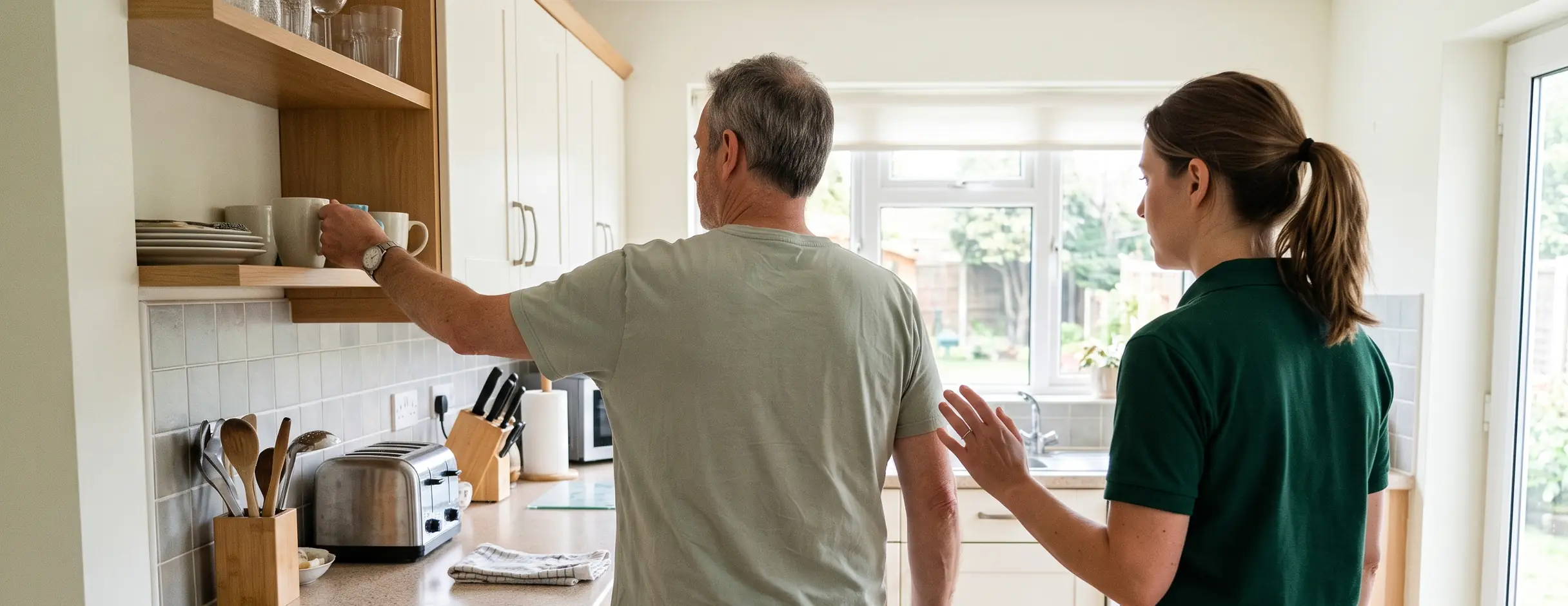
Cognitive Training
Improving memory, attention and action planning, using paper-based or computer-assisted methods.
More on this: Cognitive training
Mobility Training
Targeted training of movement control of the weakened and affected limbs and of the trunk.
More on this: After a stroke
ADL Training
Training everyday activities such as dressing, eating and housework in realistic situations, taking trunk and movement control into account.
More on this: Hemiplegia in everyday life
Evidence-Based Concepts
We work with internationally recognised treatment concepts such as , and , to make the best possible use of neuroplasticity.
Bobath: A concept for calming and for perceiving the boundaries of the body. It works among other things with positioning and changes of position.
Affolter: Guided activities are practised and improved with tactile support from the therapist.
Perfetti: Through a cognitive-therapeutic approach, neurological movement deficits are trained in the mind first.
Home-Based Treatment
We also come to your home if the journey to the practice is difficult for you.
More on this: Occupational therapy at home
Knowledge
Read more: Neurology
Plainly written specialist articles on the questions we are asked most often in this speciality.
After a stroke: using the hand again
After a stroke, movement control often returns in the leg, the shoulder and the elbow before it returns in the hand. The hand keeps you waiting longest, and it is the part you need for almost everything. This text explains why that is and what helps at home.
16 minutes to readRead
Cognitive training: memory, concentration, planning
After a stroke, a brain haemorrhage or an accident with a head injury, something often remains that nobody can see. Concentration does not hold out, and a piece of work that was begun gets stuck halfway. This text explains what is practised against that and what such practice demonstrably achieves.
17 minutes to readRead
Hemiplegia in everyday life: dressing, eating, washing
Hemiplegia does not change one movement, it changes all of them. Dressing, breakfast, showering, getting up from the bed: every one of these is built for two hands. Much of it can be done independently again with a changed order and a few adaptations. This text shows the ways that have proved themselves, as a collection of possibilities rather than a set of rules.
16 minutes to readRead
MS and fatigue: dividing the day so that strength is left
The day starts empty already. Not tired after a short night, but empty as after a march that nobody saw. This text explains what fatigue in multiple sclerosis is and how a day can be divided so that something is left by the evening.
17 minutes to readRead
Parkinson’s in everyday life: small handwriting, stiff hands
It shows up first when signing something: the letters grow narrower towards the end of the line. Later, doing up buttons takes longer, and in a doorway the feet suddenly stick to the floor. This text explains where that comes from and which everyday handling makes a difference.
18 minutes to readRead
Were you prescribed occupational therapy?
We coordinate everything with your health, accident or disability insurer. For further information, please give us a call.