What is the difference between flexor and extensor tendons?
Flexor tendons lie on the palm side and pull the fingers into a fist. Extensor tendons lie on the back of the hand and open it. Flexor tendons run in tight sheaths under pulleys, extensor tendons lie flat and broad directly under the skin. So they are injured differently and treated differently afterwards.
A tendon is not a muscle but the rope with which a muscle in the forearm pulls on a finger bone. Each of the long fingers has two flexor tendons: one attaches to the middle phalanx, the other to the end phalanx; the thumb has only one. If only one is cut, the finger still bends partly, and the injury is easily missed.
Flexor tendons are almost always injured by a cut, on glass or a knife. Extensor tendons, by contrast, often tear without an open wound, because a knock against the fingertip levers them off the bone. So people with a torn extensor tendon often go to a doctor or a therapist only after several days.
- A finger that can no longer be actively bent speaks for an injured flexor tendon.
- A finger that can no longer be actively straightened speaks for an injured extensor tendon.
- The fingers can usually still be moved passively, and that rules nothing out.
- Numbness along one side of a finger suggests a nerve has been injured as well, since it runs directly beside the tendon.
Why are flexor tendon injuries more difficult than extensor ones?
Flexor tendons glide in a tight canal of sheath and pulleys, in places over several centimetres. There is barely room in that canal for a swollen repair, the blood supply is sparse in places, and any scar between tendon and canal wall blocks the gliding. Extensor tendons have no such gliding bed.
You can picture the flexor tendon as a rope in a guide tube. The tube holds the rope close to the bone so that the force arrives where it should. After a repair the tendon is thicker at the repair site than before, but it has to pass through the same tube. And it has to start moving early enough that the scar forming does not fix it to the tube.
If the tendon sticks down, the finger stays passively mobile but not actively: your therapist can bend it, you cannot. If it stays that way, a second operation is needed to release the adhesions. On the back of the hand the situation is simpler, because no tight canal guides the tendon there.
On top of that comes the pull of the muscle. A cut flexor tendon is pulled back towards the forearm by its muscle, sometimes far into the palm. So the repair is an urgent operation, to be carried out within a few days if possible and at the latest after about two weeks. An open wound in the palm therefore belongs in medical assessment the same day.
What do the zones mean in a tendon injury?
The zones describe where along its course the tendon was injured. Flexor tendons are divided into five zones from the end phalanx to the forearm, extensor tendons into several zones from the end joint to the forearm. From the zone follows how the repair is done and which aftercare protocol applies.
The zone is not a measure of severity but a statement of place. It appears in the operation report and it is the reason why two people with the same diagnosis get different instructions. “Zone 2” means the stretch within the finger where both flexor tendons run together through the tight sheath.
- Flexor zone 1: from the end phalanx to the insertion of the superficial flexor tendon.
- Flexor zone 2: the tight section within the finger, historically called “no man’s land”.
- Flexor zone 3: the palm between the tendon sheath and the carpal tunnel.
- Flexor zone 4: the carpal tunnel itself.
- Flexor zone 5: the forearm above the wrist.
- Extensor tendons: the zones alternate, the odd ones lying over the joints and the even ones between them over bone.
With extensor tendons the treatment depends heavily on the zone. Over the back of the hand the tendon is often repaired and moved early under protection; at the end joint, by contrast, a tear frequently does without an operation. At the middle joint it is the central slip, the middle part of the extensor tendon that attaches to the middle phalanx, that decides whether the finger develops a lasting deformity.
Why may a repaired tendon neither stand still nor be loaded?
Because both mistakes have their own result. If the tendon lies still for weeks, it grows into its surroundings and no longer glides. If it is loaded too early, the repair gives way and tears. So the aftercare deliberately guides the tendon along a narrow strip between them.
On the day of the operation the repair is as strong as it is going to be for the time being. In the first week it loses strength, because the tissue at the suture holes softens before healing takes hold. Only from about the third week does its capacity rise again, reaching a large part of the original strength after around twelve weeks. From that course follow the time frames of the aftercare.
That leads to something that feels wrong: exactly when the hand hurts most and is at its weakest, the repair is at its most vulnerable. Whoever then grabs the handrail or reaches reflexively for a falling object puts more force on the repair than any exercise does.
Tissue that grows in from the outside also takes part in the healing at the repair site. It is exactly that tissue which holds the tendon fast if it stays put. The aim is therefore movement without force: the tendon should glide without pull coming onto the repair.
What does early controlled movement mean and how long does the splint stay?
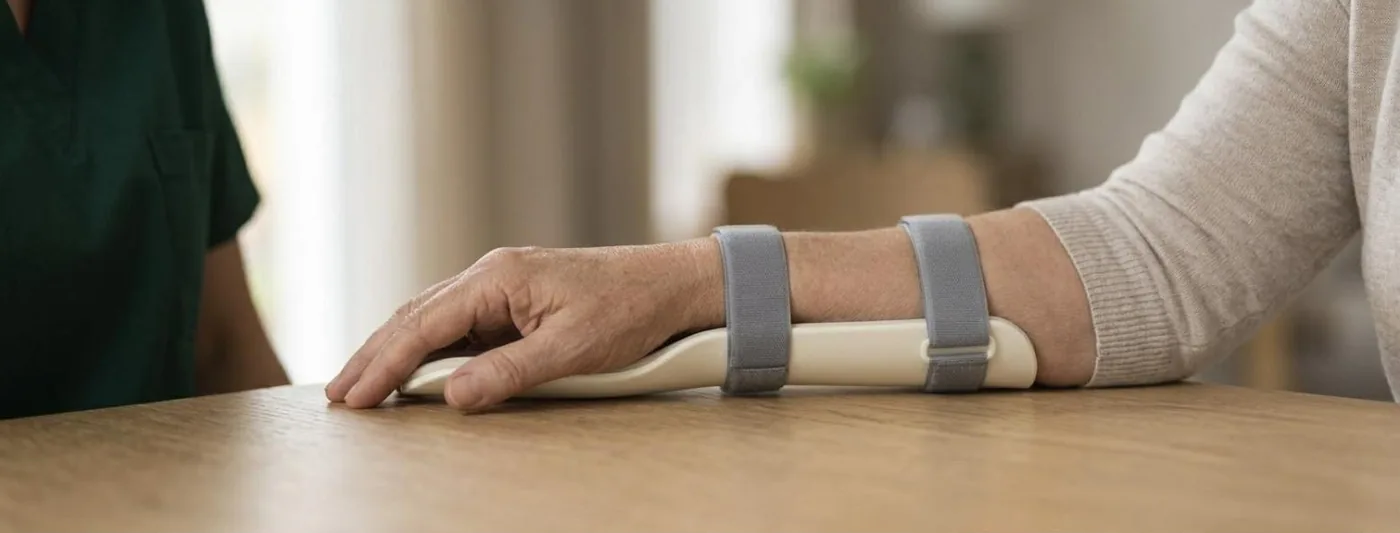
Early controlled movement means the tendon is moved from the first days, but only inside a splint that limits how far it can go, and without resistance. After a flexor tendon repair that splint stays as a rule for six weeks day and night, and often for some weeks at night after that.
The splint holds wrist and fingers in a position in which the repaired tendon gets no pull. Within that position it is moved: in the classical protocols the therapist moves the fingers passively, in other protocols you move them yourself, but only so far and so gently that the repair stays safe. Both routes are in use, and which one applies is decided by the surgeon who operated.
After that the course is staged over weeks. From about week 6 the fist is closed fully and actively outside the splint, still without resistance. Between weeks 8 and 12 light to moderate load comes in. Full load, meaning gripping, carrying and working with tools, is as a rule allowed from about twelve weeks. Extensor tendons have their own time frames depending on the zone, often likewise around six weeks of protection.
These dates are rule values, not an assurance. Your protocol can be shorter or longer, for instance because a nerve or a bone was dealt with as well. Where your protocol and this text disagree, your protocol holds. How an aftercare period runs in practice is set out in the article on hand therapy after surgery.
- Bring the aftercare protocol and the operation report to your first appointment.
- Clarify whether your protocol provides for passive or active movement, and from when.
- Ask when the splint comes off during the day and when at night.
- Get in touch with hand therapy early: the starting point is in your protocol.
What is a mallet finger and how is it treated?
A mallet finger arises when the extensor tendon tears off at the end phalanx, usually from a knock against the straightened fingertip. The end phalanx droops and can no longer be lifted actively. It is treated as a rule without an operation: the end joint is splinted straight for six to eight weeks without any break.
The accident is unspectacular. A ball hits the fingertip, or the hand runs into the mattress while making a bed. Afterwards the last phalanx hangs down and no longer lifts actively. Pain is often slight, and that is why many people only go for assessment after several days.
There are two forms: either the tendon itself tears, or a piece of bone breaks out of the end phalanx with the tendon attached to it; that is called a bony avulsion. An X-ray settles it. Surgery is used above all when a large part of the joint surface has broken off with it or the joint shifts. Otherwise the splint is the treatment of choice, even some weeks after the accident.
What matters is not the model of splint but a single condition: the end joint must not be bent during these weeks. That holds for washing and for changing the splint too. How to manage that at the basin is shown by hand therapy when the splint is fitted. The middle joint, by contrast, should stay mobile.
After the wearing time the splint is tapered off, usually still at night and during sport for some weeks. A residual deficit of a few degrees often remains without being a nuisance in daily life. Untreated, a deformity can develop over months in which the middle joint over-straightens and the end phalanx stays bent.
What happens if I leave the splint off too early?
In mallet finger the clock as a rule starts again as soon as the end joint has been bent in between, because the healing tendon is pulled apart again. After a tendon repair the repair can give way. Then the movement is missing once more, and a second operation is needed with poorer prospects than the first.
The two situations are strict in different degrees. In mallet finger the tendon only heals as long as its ends lie against each other without a break. Every bend pulls them apart, and the healing that has begun is as a rule lost. The time frame is therefore not a recommendation but the treatment itself, and the splint is worn without exception.
After a tendon repair it is about force rather than position. A rupture rarely happens while exercising and often in daily life, such as pushing up out of bed or holding on in a bus. How often that happens is reported very differently depending on repair technique and protocol; reliable percentages cannot be derived from it.
The second way an aftercare period fails is the quieter one. Whoever wears the splint correctly but out of fear does not move at all has, after six weeks, a safe repair and a stiff finger, because protection and measured movement only make up the treatment together.
If you are unsure whether a movement is allowed, leave it out and ask. For an appointment with your doctor’s prescription, use booking; in Thalwil and the neighbouring communities treatment at home is also possible where the prescription provides for it.