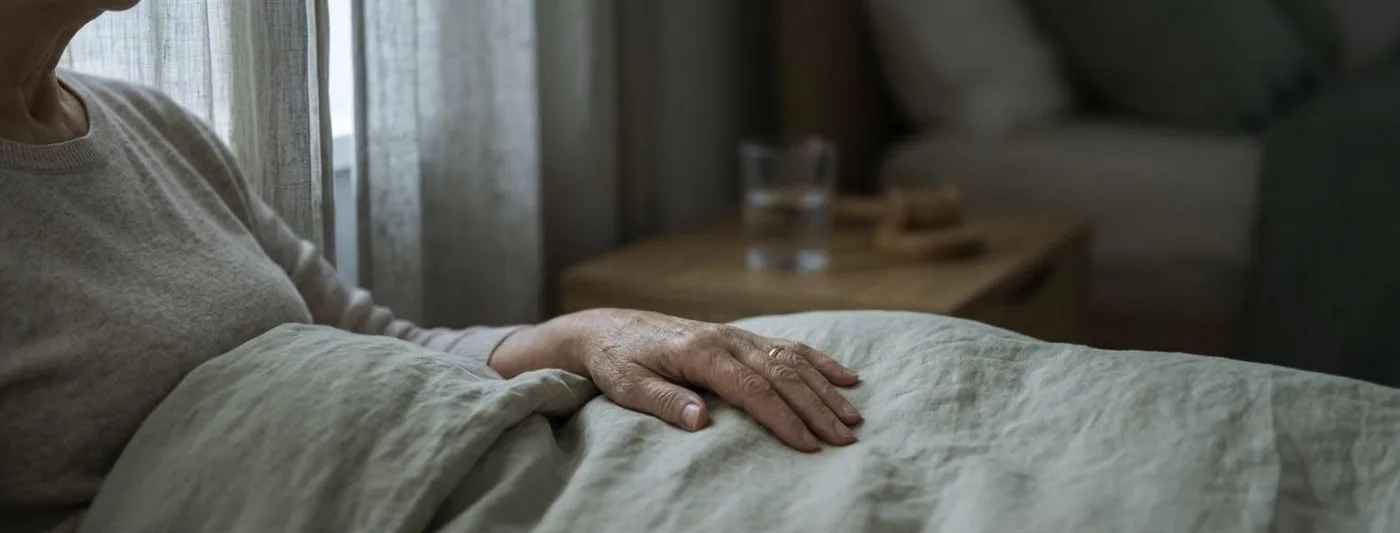
Why does a hand fall asleep at all?
A nerve needs room and a blood supply. If it is pressed, it first reports wrong signals rather than none: it tingles or feels furry. If the pressure lasts only minutes, the nerve recovers fully. If it returns every night over weeks, the insulating layer of the nerve fibres suffers.
Feeling on the skin, sensation in the technical term, is one of the two main signals the nerves in our limbs have to carry. Alongside sensation there is motor function, the control of the muscles. These two work very closely together, and that is why it rarely stays with tingling alone: if the pressure persists, fine motor skill and strength also fall away over time.
The nerves for the hand begin at the cervical spine, run under the collarbone and past the elbow and end in the fingertips. Along that route it becomes tight several times, for instance at the opening between two neck vertebrae, in the bony groove at the elbow, and in the canal at the wrist.
So a single numb finger on its own says little about where the problem sits. A numb little finger can come from the elbow, from the wrist or from the neck. What tells the causes apart is the exact pattern: which fingers precisely, which side of the finger, and whether the back of the hand is involved.
Falling asleep briefly after an awkward position is harmless. It becomes notable when the same pattern returns, when it stays during the day too, or when strength is lost. The longer a nerve is under pressure, the longer its recovery takes.
Which fingers belong to which nerve?
Three nerves supply the hand, and each has its own territory. The median nerve takes the thumb, index and middle finger and the thumb side of the ring finger. The ulnar nerve takes the little finger and the other half of the ring finger. The radial nerve takes a strip on the back of the hand between thumb and index finger.
Where these three nerves come from is shown in the drawing. The spinal cord and the brain form the central nervous system; that is where the commands to move arise and where the reports from feeling arrive. As soon as a nerve root leaves the spinal cord, the peripheral nervous system begins, the part that runs out into arm and hand. Below the neck the roots gather in a plexus and re-sort themselves there; only afterwards do the ways divide into radial, median and ulnar nerve. So a pattern of symptoms that follows several of these nerves at once says something different from one that stays exactly within one territory.
The ring finger is the key. It is divided lengthways: its thumb side belongs to the median nerve, its little-finger side to the ulnar nerve. If you notice that exactly one half of this finger tingles, you have one of the most useful clues there is. With an irritation in the neck, the finger is rarely halved so exactly.
- Median nerve, narrowed in the carpal tunnel: thumb, index finger, middle finger, half the ring finger. Worse at night, shaking improves it. More on this in the article on carpal tunnel syndrome.
- Ulnar nerve, narrowed in the groove at the elbow: little finger, half the ring finger, and the outer edge of the back of the hand. Worse when bending the elbow and when leaning on it.
- Ulnar nerve at the wrist, for instance from the pressure of a bicycle handlebar: the same fingers, but sensation on the back of the hand stays normal, because its skin branch leaves higher up.
- Nerve root at the neck: the spread follows a strip over shoulder and arm into the fingers, often with neck pain as well.
A second clue lies in the palm. In carpal tunnel syndrome the skin over the ball of the thumb usually stays normal, because its skin branch leaves before the narrow canal. If the ball is numb too, the cause sits further up the arm or in the neck.
Why do hands fall asleep at night and in the morning?
At night the muscle pump is missing, the tissue becomes a little damper, and the pressure in narrow canals rises. Position comes on top: many people sleep with the wrist strongly bent or with the elbow folded under the head. Both narrow exactly the places where the nerves have little room anyway.
A bent or over-straightened wrist markedly raises the pressure in the carpal tunnel. An elbow bent past ninety degrees tightens the ulnar nerve in its groove and presses it against the bone. Lie like that for hours and you irritate the nerve for hours. That explains why waking at night is typical of both narrowings.
Pure positioning is recognised by the fact that it can be changed and passes quickly. A hand that has fallen asleep because weight lay on it is normal again after two to three minutes. Carpal tunnel syndrome wakes you night after night, often several times, and needs longer before the feeling comes back.
- For two weeks, note how often you are woken at night and which fingers are affected.
- During that time deliberately change the sleeping position: do not lie on the arm and do not fold the elbow under the head; the wrist stays straight.
- If it still happens several nights a week, a medical assessment is worth more than carrying on experimenting.
- A resting splint for the night holds the wrist in a neutral position. It helps in carpal tunnel syndrome and equally with other nerve compressions, such as at the elbow, where a resting splint keeps the bent elbow open.
The same holds during the day for positions held for a long time, such as the phone pressed to the ear or the forearm on the table edge while typing. More on screen work and the mouse grip in the article on mouse arm in the home office.
Does the tingling come from the neck or from the hand?
For the neck speak pain running from the cervical spine over the shoulder into the arm, a worsening when turning or tilting the head, and a worsening when coughing or sneezing. For the hand speak a cleanly bounded finger territory and waking at night without any neck pain at all.
With an irritated nerve root, a disc or a bony narrowing usually presses on the root before it leaves the spine. Most often that affects the roots C6 and C7. C6 runs to the thumb side, C7 towards the middle finger, C8 to the little finger. These strips overlap from person to person.
So a radiculopathy is not established from the tingling pattern alone. Your doctor tests reflexes, strength and sensation side by side, and carries out a test in which the head is tilted towards the affected side and lightly pressed. If that sets off the arm pain, it speaks for the root.
The outlook is good. The guideline on cervical radiculopathy states that most people with a disc prolapse improve within four to six months, and that within two to three years a large proportion recover fully. An operation is rarely needed.
Both at once exists. A nerve root can be irritated and the nerve at the wrist narrowed as well. If only one is treated, part of the symptoms remains.
What does tingling in both hands and feet mean?
If both sides are affected and it starts at the feet, a polyneuropathy comes to mind. Many small nerve fibres are damaged, first where they are longest. The pattern is like a stocking and a glove: it does not keep to single nerves or single fingers.
Typical are burning and tingling in the feet and a feeling of walking on cotton wool. The hands often follow later. Someone who complains of numb fingers and, when asked, also notices numb toes, is in a different situation from someone with a single narrowing.
- The most common causes are diabetes, years of high alcohol consumption, a lack of vitamin B12, and certain medicines, among them agents used in chemotherapy.
- Around a quarter of polyneuropathies remain unexplained despite a thorough search.
- Assessment is by neurological examination, blood tests and a measurement of nerve conduction.
- The cause is treated first. In diabetes, control of the blood sugar is the lever that protects the nerves.
In hand therapy the point with a polyneuropathy is not to repair the nerves. It is to grip safely with less sensation: avoiding injuries and burns, because the warning is missing, enlarging handles, and keeping strength and fine motor skill.
What lies behind cold, white fingers?
When fingers suddenly turn white in the cold or with excitement, then go blue, then come back red and painful on warming, it is usually Raynaud’s phenomenon. The small arteries contract in spasm. Here the tingling does not come from pressure on a nerve but from the missing blood supply.
The colour change from white through blue to red is the hallmark. It usually affects several fingers, often on both sides, and stops at a sharp border. An attack lasts minutes to hours. It is set off by cold, sometimes by reaching into the freezer, and by emotional tension.
A primary form without an identifiable underlying illness is distinguished from a secondary one that belongs with a rheumatic disease, with medication, or with years of work using vibrating tools. The second is why Raynaud’s phenomenon belongs in a medical assessment, especially when it begins late in life or affects only one hand.
Open areas on the fingertips should be assessed promptly, as should a hand that stays cold, pale and weak without warming up again.
How is it assessed, and who does that?
The first route is to the GP practice. There the course, the pattern, reflexes, strength and sensation are recorded. Depending on the suspicion, neurology follows with a measurement of nerve conduction, an ultrasound or MRI scan, or a blood test. Your doctor makes the diagnosis, never the therapy.
Nerve conduction studies measure how fast and how strongly a nerve conducts. They separate a narrowing at the wrist from one at the elbow. With a suspected root irritation, an MRI of the cervical spine is used instead; the guideline notes that electromyography stays normal in a proportion of root injuries.
Occupational therapy comes in once the cause is known and daily life is suffering from it. Treatment is on a doctor’s prescription and billed to the insurer responsible; the deductible (Franchise) and the retention fee (Selbstbehalt) run through that insurer. How a prescription comes about is set out in the article on being prescribed occupational therapy.
- Adapting workplace, tool handles and sleeping position, so that the pressure on the nerve can be taken off.
- Nerve gliding exercises and measured loading, placed realistically: the evidence for these is thinner than their spread suggests.
- Making and fitting a splint for the night.
- Training grip and fine motor skill, and advice on protection, once sensation has fallen away.
If you are unsure whether your pattern belongs in hand therapy, we are glad to discuss it; the assessment itself stays medical. Arrange an appointment through the booking page, and ask questions beforehand through the contact form.