Which question does each of the two professions ask?
Physiotherapy asks how the body moves and what stops it. Occupational therapy asks which action in daily life no longer works and why. One starts at structure and function, the other at the task you want to carry out again.
Both professions look at the same person, but they begin in different places. Physiotherapy is the field for movement and bodily function: the mobility of a joint, the strength of a muscle, balance, endurance, pain under load. The Swiss professional association describes physiotherapists as specialists for movement behaviour, bodily function and physical performance.
Occupational therapy is the field for the ability to act. The Swiss professional association divides its fields of work into self-care, productivity and leisure: washing and dressing, work, household and school, hobbies and social life. The starting point is not the joint but the task that hangs on it.
Behind this stands a model both professions share: the international classification of functioning of the World Health Organization. It separates bodily functions and structures from activity and participation. Physiotherapy has its centre of gravity more on the first level, occupational therapy more on the second, though that is a viewpoint and not a fixed border.
- Physiotherapy: “the wrist does not yet bend far enough, and the strength is missing.”
- Occupational therapy: “your hand does not reach the button on your trousers, and the glass slips.”
- Both sentences can describe the same finding and still lead to a different treatment.
What does an occupational therapist actually do?
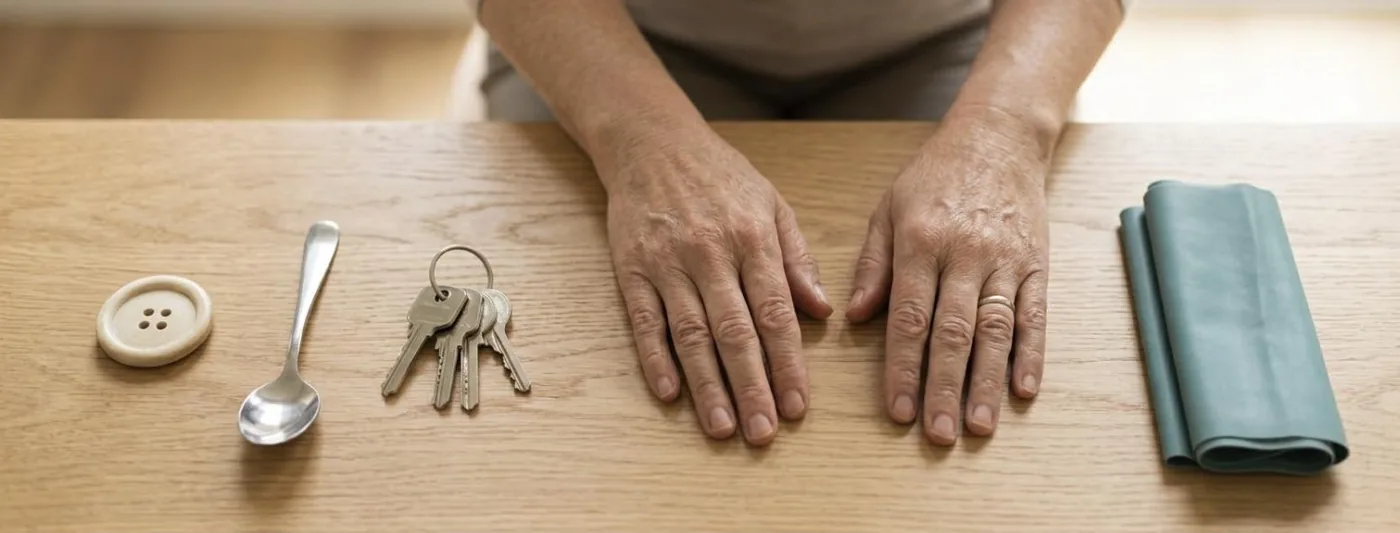
Occupational therapy starts at an action that matters to you: closing buttons or turning a key. Practice happens at that action itself. Added to it are splints, adapted everyday objects and changes at home or at work, when the route through function alone is not enough.
At the beginning stands an assessment that looks different from a pure test of function. Measurements are taken as well, but the real question is this: what do you want to be able to do again in four weeks that does not work today? Out of that comes a goal that can be checked, and the rest of the treatment hangs on it.
The second difference lies in the toolbox. Occupational therapy is allowed to change the route to the action when the direct route stays blocked. A thicker handle on the cutlery or a grab rail beside the shower: adaptations of that kind are not a last resort but a part of the field in their own right.
- training at the task itself rather than only at the movement behind it
- making and fitting splints, above all after injuries and operations on the hand
- scar treatment, sensitivity training and building up load tolerance in use
- advice on assistive devices and on setting up the home and the workplace
- training attention, memory and the planning of actions after neurological illness
What occupational therapy is expressly not: a field only for children. That idea is stubborn. The professional association names people of every age as its target group, and in our practice it is mostly adults who sit down, after hand surgery or after a stroke.
Where do the two professions overlap?
At the hand and in neurology they lie close together. The title of certified hand therapist Switzerland can be earned by specialists from occupational therapy and from physiotherapy. After a stroke both practise movement. The difference then lies less in the profession than in the agreed goal.
Hand therapy is the best example. In Switzerland it is not a basic training of its own but a further qualification, and the specialist society for hand rehabilitation admits exactly two basic professions to it: occupational therapy and physiotherapy. Whoever fits your splint has therefore not necessarily studied occupational therapy, but in every case holds this qualification.
In practice a division of labour has nevertheless settled in. Outpatient aftercare of the hand often runs through occupational therapy, because splint making and everyday training come together there. How it is arranged in a given place depends on what is on offer locally and not on a rule. More on this in hand therapy after surgery.
The second large overlap is neurology. After a stroke both professions work on movement, and both work intensively. Physiotherapy often turns its attention to trunk, legs, walking and balance, occupational therapy to the arm and the hand in use, and to perception and self-care. Where exactly the line runs is settled by the treating team.
What training stands behind the two professions?
In Switzerland both lead through a bachelor course at a university of applied sciences, as a rule three years. In occupational therapy about a third of the course is spent on placements. After that come further qualifications, in hand therapy or neurorehabilitation. There is no gap in training between the professions.
The occupational therapy course comprises one hundred and eighty credit points and is offered at four universities of applied sciences: two in the German-speaking part, one each in the French-speaking part and in Ticino. About two thirds take place at the school, one third in placements in the field. The degree entitles the holder to practise; a master is possible but not a requirement.
For physiotherapy the bachelor of science at a university of applied sciences is likewise the entry qualification, with master and doctoral levels above it. The content differs in its weighting: movement science and training theory on one side, analysis of actions and provision of devices on the other.
When does it make sense to have both therapies at once?
When a problem hits the body and daily life at the same time, both side by side make sense. After a stroke physiotherapy often works on walking and balance, occupational therapy on arm, hand and self-care. What is needed then is that both know the same goal and talk to each other.
Rehabilitation after a stroke is a joint effort of several professions from the very start. Publicly available patient information from university clinics describes exactly this approach: early start, high density of practice, a shared goal, regular reassessment. The division arises from the goal and not from an order of competence. How daily life is rebuilt afterwards is described in after a stroke.
- after a stroke: walking and balance on one side, arm, hand and self-care on the other
- after a larger injury with several parts of the body affected
- in progressive neurological illness, when mobility and coping with daily life decline together
- before a planned return to work, when both load tolerance and the workplace have to be adapted
Two therapies side by side mean two appointments and two prescriptions. For people who tire quickly, that double load can become a problem. Say so. Sometimes it is more sensible to run one therapy first and the other later, instead of both half-heartedly at the same time.
Who prescribes what, and how does the insurer pay?
Both run through the insurer that is responsible and both need a prescription. Physiotherapy may be ordered by doctors and by chiropractors, by dentists only within dental treatment; occupational therapy only by doctors. One order covers at most nine sessions in both cases.
The federal ordinance on benefits in compulsory health insurance regulates both therapies in two neighbouring articles, and the structure is almost identical. One difference stands out: the time limit until the first treatment is five weeks from the medical order for physiotherapy, and eight weeks for occupational therapy.
- at most nine sessions per prescription; after that a new one is needed
- first treatment: physiotherapy within five weeks, occupational therapy within eight weeks
- from a total of thirty-six sessions the insurer’s medical adviser examines whether treatment continues
- in case of illness the health insurer pays, after an accident the accident insurer; the deductible (Franchise) and the retention fee (Selbstbehalt) are yours to carry
- if the accident runs through the employer’s compulsory accident insurance, deductible and retention fee do not apply; if it is covered through the health insurer, as for pensioners, children or people not in employment, they apply as in illness
Two therapies at the same time mean two orders. A prescription for physiotherapy does not cover occupational therapy and the other way round. What is missing on the form is not billed by the insurer. The procedure, the time limits and your share of the cost are set out in detail in occupational therapy on prescription.
How can you tell which therapy you need?
Picture what you want to do again the next morning. If it is about how a joint moves or how far you can walk, the way usually leads to physiotherapy. If it is about a particular task that fails, usually to occupational therapy.
You do not decide the allocation on your own, and you do not have to. The prescription is written by a doctor, and it says which therapy is meant. You can prepare the conversation, though, and one single sentence is enough for that.
- Write down one concrete task that has stopped working recently, as precisely as you can.
- Add what, as far as you can tell, it fails on: strength, mobility, pain, sensation, endurance or uncertainty.
- Take both to the consultation and say it at the start.
- Ask if the allocation on the prescription does not make sense to you.
A sentence such as “I cannot get the lid off the jam jar any more” says more in the consulting room than “my hand hurts”. It names an action and a resistance. Out of sentences like that comes a treatment goal that can be checked, whichever of the two professions ends up taking it on. Which fields we cover is set out under our specialities.