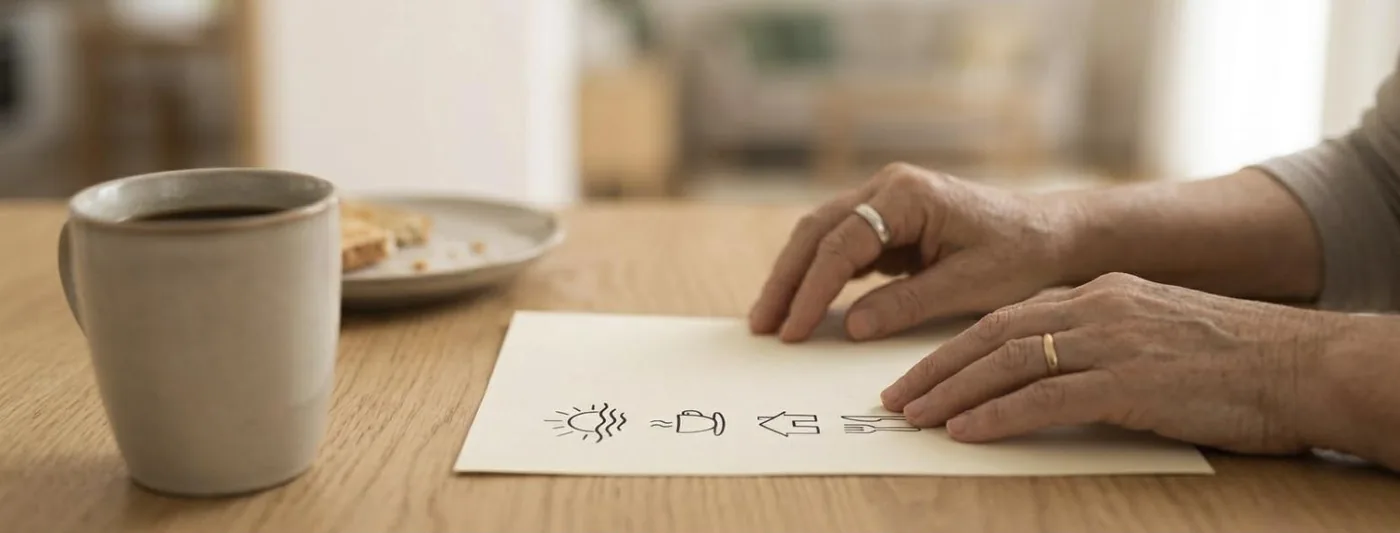
Why does a fixed daily structure carry the day?
A fixed daily structure takes work off the memory. Anyone who has breakfast at the same time in the same place every day does not have to remember, only to repeat. Familiar sequences stay available for a long time in dementia, even when recalling details has long stopped working, and every repetition saves a decision.
Dementia affects the kinds of memory unequally. What was discussed yesterday is often gone. How to make coffee or lay a table frequently remains when the names of the grandchildren are already missing. This ability within a sequence is what carries the daily structure.
So the structure grows out of the life lived so far, not out of a plan at a desk. Someone who got up at half past six for forty years gets up at half past six. The order counts for more than the clock: toilet first, then washing, then dressing, then eating.
- Fixed times for getting up, meals, a walk and going to bed, at the weekend too.
- Each activity in its own place, so that the place remembers as well.
- Anything demanding in the morning, when strength is greatest.
- Out into the daylight every day, even if only to the bench in front of the house.
- A large wall calendar and a clock with the date, in a fixed spot.
A study that tested the daily structure as a single measure is not known to us. What is evidenced are building blocks of it, for instance that physical and social activity during the day can slightly improve sleep at night; the structure as a whole is reasoned, then, but not measured.
How do you adapt the home to dementia?
The home should give the answer before the question comes. That means bright, glare-free light, a strong difference in colour wherever something has to be found, picture and word on doors and cupboard doors, a night light on the way to the toilet, and everything dangerous out of reach.
The eye needs more light with age, and in dementia shadows and reflections are misread. Bright and free of glare is the rule: several lamps rather than one strong one, matt rather than shiny surfaces, and no dark corner in the hallway. Cooler light in the morning and warmer light in the evening is regarded as sensible; the evidence for it is thin, and it can do no harm.
The following points are recommendations from practice and practical tips, not rules. What fits is decided at the home itself and by what is familiar to the person concerned.
- A coloured toilet seat on a white bowl, so that the toilet is recognised.
- A plate with a coloured rim or a coloured place mat, so that the food stands out.
- Handrail, light switch and door handle in a colour that contrasts.
- Chequered patterns and patterned rugs go, because they are read as steps or holes.
- Blue-grey or shiny floors look like water and make people stop.
- Take down large mirrors if your own reflection frightens you as a stranger.
Labels use picture and word together: a photograph of the cups on the cupboard door, the word beneath it in large letters. What matters is few signs in the right places. Anyone who labels every door creates a wall of paper in which nothing stands out any more.
- A cooker safety device with automatic switch-off, or a knob that can be pulled off, prevents the forgotten pan.
- Limit the water temperature so that nobody scalds themselves.
- Lock medicines, cleaning products and alcohol away, and sort out anything spoiled.
- A night light with a motion sensor along the whole way from the bed to the toilet.
- That route stays free of rug edges, cables and chairs, with the door open or lit.
- Against leaving the house at night, a door sensor or a pressure mat with a signal in the bedroom helps.
Anyone who gets up unsteadily at night is at risk of falling as well. The measures against falls and those against disorientation overlap strongly, so it is worth reading our article on fall prevention before you start moving things around.
How do you tailor an activity so that it succeeds?
Break the activity into single steps, lay the materials out in the order they are used, clear everything else away and give only one instruction at a time. Take on the hardest step yourself and leave the rest with the person who is ill.
Being overwhelmed rarely looks like being overwhelmed. It shows as irritability or as walking away in the middle of the action. Behind it there are usually too many steps at once, which is why the goal is the share of the task that succeeded, not the finished task.
- Choose an activity that used to matter: preparing a salad, folding the washing.
- Prepare the place: only the material needed, in the order it is used.
- Say the first step briefly and wait. Show rather than explain.
- Only when that step is done does the next one come. No two instructions in one sentence.
- Take over silently what no longer works, for instance the hot pan.
- Finish before the strength runs out, and leave the result as it has turned out.
Mistakes are not corrected but bypassed. Saying that it is the wrong way round produces shame and usually a breaking-off. Prompting the next action instead, or quietly putting the piece the right way round, keeps the activity going: errorless practice.
An American series of studies on tailored everyday activities is often cited as evidence that restlessness and aggression can be reduced this way. The results on that vary from study to study; what improved robustly was above all the need for help in daily life and the confidence of those providing care.
Why is it about doing rather than memory training?
Memory cannot be practised back in dementia. Asking who is in the photograph or what day of the week it is produces failure and usually resistance. What does remain is the ability to carry out familiar actions when somebody starts them off and stays alongside.
The difference concerns more than the tone. Testing aims at exactly the function the illness destroys. Everyday activities aim at what still works, and so they end more often in a laid table than in frustration.
Separate from that is cognitive stimulation: guided rounds of conversation and activity about memories and everyday things, usually in a group. A Cochrane review of 2023 with 37 studies and 2,766 participants found a small benefit for thinking performance, around two points on a common test, and a clearer effect on conversation and participation. For memory training on its own that evidence is missing.
Where the limits of such methods lie is described in the article on cognitive training. For daily life at home that means: do not test, let people join in.
How do you talk with a person who has dementia?
Approach from the front, seek eye contact and speak slowly in short sentences, one thing per sentence. Ask questions that can be answered with yes or no. Do not contradict; pick up the feeling behind what was said. The examples below show what that looks like in daily life.
- Eye contact first, then speak. Being addressed from behind is frightening.
- One thought per sentence, and no negatives.
- Names rather than pronouns: “Anna is coming” rather than “she is coming”.
- After a question, wait, even if it takes a long time. Answers need time.
- When words are missing, do not supply them; offer the direction instead.
- Do not point out mistakes, do not change the subject, switch the television off.
The hardest thing is statements that are not true. To the sentence that mother will be here shortly, neither the truth nor an invented story helps, but the feeling behind it: you are missing your mother. After that, a move into an activity. Solid studies on the effectiveness of individual rules of conversation are missing, though.
What has been studied are courses for family members. They are part of the multi-component programmes that reduce the burden on those providing care. The benefit there lies less with the person who is ill than with those who spend the day with them.
What helps with restlessness in the evening?
Look first for a physical cause: pain, needing to pass water, constipation, hunger, thirst, tiredness or a new medicine. If none of that is there, what helps is a quiet evening with few stimuli, bright light without shadows, closed curtains and the same order of things every night until bedtime.
Restlessness in the evening has acquired a name of its own, sundowning. That does not explain it. What suggests itself is exhaustion after a demanding day, fading orientation at dusk, and the bustle that starts up at that hour.
- Close the curtains before it gets dark, and put the lights on in the room.
- No appointments and no group visits in the evening; the television stays off.
- Get outside and stay moving during the day; keep any afternoon nap short.
- Leave out coffee, black tea and alcohol from the afternoon on.
- Always the same order in the evening, down to the same music and the same armchair.
- Anyone who wants to get up is accompanied rather than held back; a round through the flat often helps.
One restriction belongs with this. A Cochrane review of non-drug measures for sleep problems in dementia assessed 19 studies with 1,335 participants and rated the certainty of the results as low to very low. What helped most was physical activity during the day. On bright light therapy, a separate review concludes that the evidence is not sufficient.
What relieves family carers in Switzerland?
Support works when it happens regularly and does not start only at the point of collapse. In Switzerland there are home nursing services, day centres, respite services by the hour at home, short stays in a care home, advice centres and groups for family carers. The way in is usually through the GP practice.
According to federal estimates with a status of 2019, around 155,000 people in Switzerland were living with dementia, about half of them without a diagnosis; around 29,500 new cases are added each year. More recent estimates are higher. Around 47 per cent of the cost of the illness arises as unpaid care by family members.
- Spitex (home nursing and home care): nursing and help in the household; nursing on a doctor’s order runs through the insurer responsible.
- Day centres and day structures: care on fixed days away from home, often with transport.
- Respite services: trained people come to the home for a few hours.
- Short stays and holiday beds in a care home for some weeks.
- Advice centres in the canton and the municipality: taking stock, funding, planning ahead.
- Groups and courses for family carers: exchange with people in the same position.
On funding: nursing provided by Spitex runs through the insurer responsible on a doctor’s order, while care and housekeeping as a rule do not. Where helplessness is established, a helplessness allowance from the Old Age and Survivors’ Insurance or from invalidity insurance may apply; the conditions are clarified by the compensation office. On the deductible (Franchise) and the retention fee (Selbstbehalt), the insurer responsible gives information.
For family members, what demonstrably works are multi-component programmes in which concrete situations are worked through and coping strategies practised, tailored to your own position. A leaflet alone barely changes the burden, because the difference lies in the practising.
What does occupational therapy do at home in dementia?
Occupational therapy comes into the home, looks at an ordinary day and works on three things: activities that should still succeed, surroundings that help with them, and instruction of the family. It does not halt the course of the illness.
This is the point at which many texts promise too much. Occupational therapy does not cure dementia. It does not measurably slow the decline. What was studied is something else, namely whether people with dementia manage on their own for longer and whether the burden on those providing care falls.
The answer is mixed. A Dutch study of 2006 with ten sessions at home over five weeks found clear improvements in everyday ability and in the burden on family members. A German repetition in 2011 and a British study in 2021 with 468 participants found no difference from usual care in their main result. The German-language guideline on dementia recommends occupational therapy in the home setting with the involvement of the people close to the person, despite this mixed evidence.
- A walk through the home looking at light, contrast, labelling, cooker, bathroom and the way to the toilet.
- Observation of a real activity, to see at which step it gets stuck.
- Building a daily structure that fits the habits of the life lived so far.
- Instruction of the family: give one instruction, wait, and do not correct.
- Trying out assistive devices in the person’s own home rather than in a catalogue.
- Fall prevention and, where needed, arranging respite services.
In Switzerland this requires a doctor’s prescription; it is billed to the insurer responsible. Treatment sensibly takes place where daily life happens, that is as treatment at home where the prescription provides for it; for that, treatment at home has to be ticked on the prescription. What occupational therapy in geriatrics otherwise covers is set out on the speciality’s page; questions you can write to us.