What can you change at home without building work?
Without building work more can be changed than most people expect: remove rugs or fix them down, cables along the wall, ramps over thresholds, stronger lighting, a night light on the way to the bathroom, furniture raised, and the routes between bed, bathroom and kitchen cleared. All of it costs an afternoon.
This stage is underestimated because it is unspectacular. It nevertheless takes effect exactly where most accidents happen: on level ground in your own living room and bedroom. The following points are recommendations from practice; what makes sense in your home is decided on site.
- Floors. Loose rugs and runners go, or get fixed down. Curled edges and transition strips are the commonest places to trip.
- Routes. The way from the bed to the bathroom, from the armchair to the kitchen and to the front door stays clear. Cables belong along the wall.
- Light. More light over the stairs, in the hallway, over the worktop and beside the armchair, plus a switch at both ends of every route.
- Night light. A weak, glare-free light on the way to the bathroom. The night-time trip is a common occasion for a fall, and in the dark people look for the switch with their feet.
- Furniture heights. Seats that are too low cost strength every time. Bed, armchair and chair can be raised with stable furniture risers or a firm cushion, without anybody drilling.
- Order at grip height. What you need daily comes to between hip and shoulder. That removes the two riskiest movements in the household: the stool and deep bending.
How much this achieves can be quantified, and the honest answer has a restriction. A Cochrane review of 2023 found that removing hazards at home lowered the fall rate by about 26 per cent, and by about 38 per cent at high risk of falling. In people without raised risk the same measure showed no benefit. So anyone who fell last year gains measurably. More on this in the article on fall prevention.
How do you make the bathroom safer without converting it?
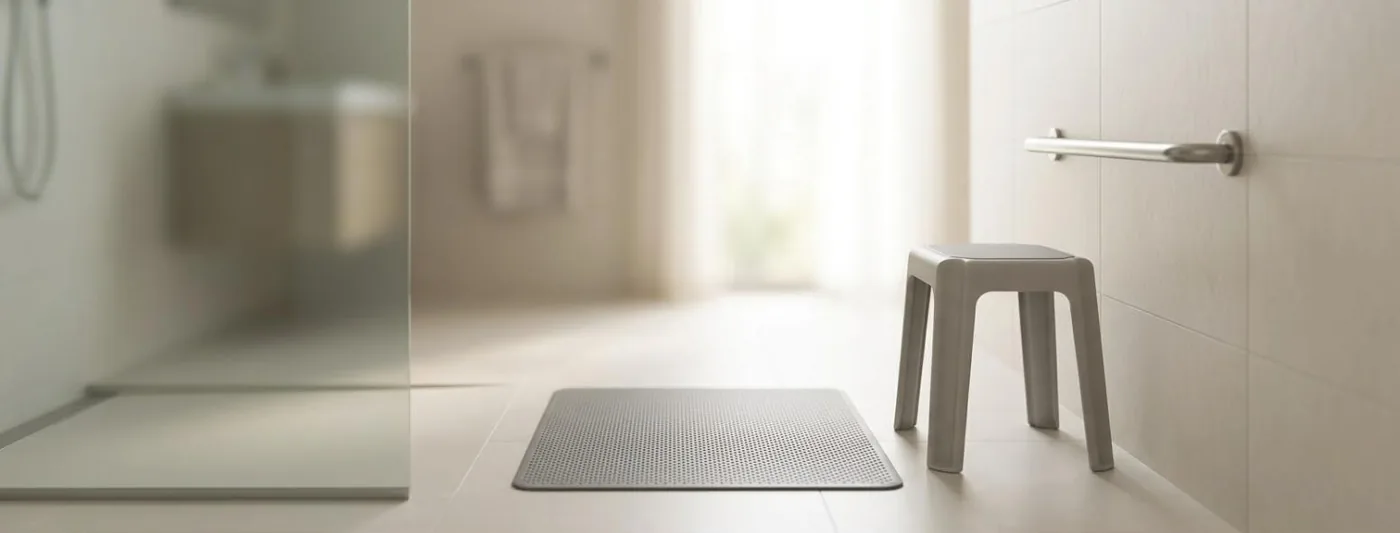
In the bathroom four things work at once and without a tradesman: non-slip inserts in bath and shower, a non-slip mat in front of them, a stool for sitting while washing, and enough light without glare. They are examples and not a complete list. Everything you need belongs within reach, so that you do not turn and bend while standing.
The seat is the most underrated measure in the bathroom. Anyone who washes and dries sitting down does not stand up on one leg on a wet floor. A stable stool with non-slip feet is enough to start with; whether a fitted shower seat is needed later is shown by trying it out.
The second point is the way into the bathroom and out again, with wet feet on tiles and a mat that slips: a chain that can be broken link by link.
Every place where you hold on to something that was not built for it is a future position for a rail. The towel rail tears out of the wall, and the basin is rarely fixed as firmly as you assume when you pull on it.
Where do grab rails belong and how are they fixed?
Grab rails belong where you already hold on today: beside the toilet, at the way into shower or bath, on the wall of the shower area and beside the front door. What is decisive is the height of your own grip and a fixing that sits in load-bearing ground, not in the tile joint.
A rail in the wrong place is worse than none: it invites you to pull where you have already lost your balance. So the position is not determined by a catalogue measurement but at your own movement.
- Observe the movement and mark where the hand reaches of its own accord.
- Establish the substrate: a solid wall carries something different from a stud wall or a service wall, meaning the clad partition behind which pipes and cistern sit.
- Have it fitted by somebody who knows the wall. A rail has to hold your whole weight, including a sudden pull.
- Ask again after two weeks: is it being used? If not, it is in the wrong place.
In the same category belong raisers such as a raised toilet seat or a higher bed. They shorten the distance your leg muscles have to cover when standing up, and where strength is lost that is often the difference between alone and with help. Which objects prove themselves is described in the article on assistive devices in daily life.
Which small alterations are worthwhile in an existing home?
Small alterations are those a tradesperson does in a few hours: screwed grab rails, a fixed shower seat, a raised toilet seat, a non-slip covering, a ramp over the threshold and extra sockets or lamps. The home stays the same, and only the critical places change.
The difference from a conversion is not the effort but whether it can be undone. A grab rail leaves four holes. A level-access shower leaves a new waterproofing layer and an invoice; that belongs discussed and decided beforehand.
- Non-slip covering. In shower and bath a durable coating or an applied covering holds better than a mat that slips.
- Threshold ramps. A firmly screwed ramp solves a problem that otherwise costs effort on every trip with a wheeled frame or a wheelchair. It has to meet the floor flush on both sides, or the next edge appears.
- Shower seat. A tip-up seat fixed to the wall needs the same load-bearing ground as a grab rail and the same check of the height.
- Light and sockets. Extra lamps and switches are a job for an electrician, not a conversion. A motion sensor in the hallway replaces searching in the dark.
- Handles instead of knobs. D-handles on cupboards and doors, longer levers on windows: small changes that make a great difference with a weak hand.
If you rent, you need the written consent of the landlord for changes to the home. Set down in the same agreement what happens to the adaptation when you move out, so that there is no dispute later about removal and costs.
When is adapting no longer enough?
Adapting reaches its limit where the floor plan is the problem: doors too narrow, a bathroom with no turning space, steps in front of the entrance, or three floors without a lift, because no grab rail makes a staircase shorter. Then conversion or a move is the fitting answer, and both need lead time.
What is structurally feasible follows in Switzerland the standard SIA 500 on barrier-free building and the guidelines on housing suited to later life and adaptable housing (fremde Seite, öffnet in einem neuen Fenster). They set out circulation areas, door widths and access. A home that does not offer these dimensions does not become barrier-free through retrofitting, only somewhat better.
The second reason is timing. A move after a stay in hospital happens under time pressure, while the same move two years earlier can be planned calmly. Anyone who takes it up early keeps the choice.
- The access is the problem, not the home: steps to the entrance, or a lift that does not stop on your floor.
- The bathroom cannot be changed so that you get in and turn with a wheeled frame or a wheelchair.
- The kitchen can only be used standing, and standing is the limiting factor.
- Bedroom and bathroom are on different floors.
- The effort of converting bears no relation to how long you would like to stay in this home. For a move there can be quite different reasons as well, such as being near the family or better transport connections.
A conversion is not a worse answer than a move, only a different one. A level-access shower or a stairlift are real options where the structure allows them and the funding is settled.
How does a home assessment by occupational therapy work?
A home assessment takes place where you live. The occupational therapist watches how you stand up, walk, wash and cook, measures heights and widths and checks the routes. Afterwards you receive a written list: what can be done at once, what has to be fitted, what stays structural.
The difference from a checklist off the internet: what is assessed is not the home but your movement within it. Two people with the same floor plan need different things, because restrictions show themselves in quite different ways, for instance in standing up, in sight, in balance or in stamina. An older version of the Cochrane review found indications that an assessment by occupational therapy achieves more than a list; the 2023 version, however, does not separate the professional group cleanly.
- Preliminary conversation: what has happened, what is hard, what would you like to do yourself again?
- Observation in daily life: standing up, walking, opening doors, stepping into the shower, taking something out of a cupboard.
- Measuring and checking: seat and bed edges, door widths, thresholds, lighting, floor coverings, walls.
- Trying out rather than assuming: stool, raiser and rail position are held in place and tested.
- A written report with priorities, separated into what can be done at once, what can be fitted, and what is structural.
- Where needed: support with the application and contact with your doctor, the family and Spitex (home nursing and home care).
Occupational therapy in Switzerland requires a doctor’s prescription; it is billed to the insurer responsible, and the deductible (Franchise) and the retention fee (Selbstbehalt) run through that insurer. The assessment belongs to the treatment, the cost of conversion does not. Because it only makes sense at home, we carry it out in Thalwil and the neighbouring municipalities as treatment at home, where the prescription provides for it; for that, treatment at home has to be ticked on the prescription. More on this under geriatrics; your questions you can write to us.
Who pays for structural changes to a home in Switzerland?
That depends on your situation, not on the object. Before the reference age, invalidity insurance may cover structural changes caused by disability, and after an accident, accident insurance. In retirement the Old Age and Survivors’ Insurance pays for no conversions; supplementary benefits, foundations and charities are then checked. A helplessness allowance widens the scope as a cash benefit.
Responsibility follows the cause of the restriction and your age, and it has to be settled before the building starts, because an inaccuracy at this point becomes expensive.
- Invalidity insurance (IV). It covers structural changes caused by disability, including ramps, lifting platforms and stairlifts, where that makes employment, a field of duties or running the household independently possible. You apply to the IV office of your canton of residence.
- Accident insurance. If the disability goes back to an accident, it is responsible, for aids and adaptations as well.
- Old Age and Survivors’ Insurance (AHV). Its list of aids is short and contains among other things wigs, orthopaedic shoes, hearing aids, magnifying spectacles and wheelchairs without a motor. Structural adaptations are not on it.
- Acquired rights. Anyone who received an aid from invalidity insurance before the reference age keeps the entitlement as long as its conditions are still met. Applying before the old age pension starts is therefore worthwhile.
- Helplessness allowance. Anyone drawing an old age pension or supplementary benefits who has needed constant help with the activities of daily living for at least six months can apply for it. It is independent of income and assets and is paid as a flat cash benefit. It is not a payer for conversions but additional income you can use freely.
- Supplementary benefits. They can reimburse costs of illness and disability that no other insurance covers, explicitly including aids. The application goes to the responsible office in your canton.
- Foundations and charities. They may cover remaining costs where no insurance applies. There too: apply before the building starts.
On amounts and on reimbursement in an individual case, your health insurer, the compensation office and the IV office give information; this text does without amounts, because they change with every revision of the leaflets.